MFLI: a multifacet learnable index for large-scale recommendation
Fidelity: core mechanism. Learns four facets—genre, two semantic-code levels, and freshness—instead of a single ANN space.
Paper information
| Field | Details |
|---|---|
| Paper | arXiv 2602.16124 |
| Organization | Meta |
| First public release | 2026-02-18 (arXiv v1) |
| Authors' code | The paper did not provide official or author code when checked on 2026-08-09. |
| Adapter / method | mfli |
| Local reproduction code | src/auto_research/reproductions/mfli/ |
Original paper
Motivation and method
ANN compresses all retrieval goals into one geometric space. Offline indexing delays fresh content, and online neighbor search becomes more expensive as candidate counts grow. MFLI learns the index jointly as model parameters, uses facets for semantics, popularity, and freshness, and allocates retrieval budgets per facet at request time.
flowchart LR
  I["item features"] --> F["multiple learned facets"]
  Q["request"] --> A["facet allocation"]
  F --> L["direct index lookup"]
  A --> L
  L --> C["merged candidates"]
Key figure from the paper
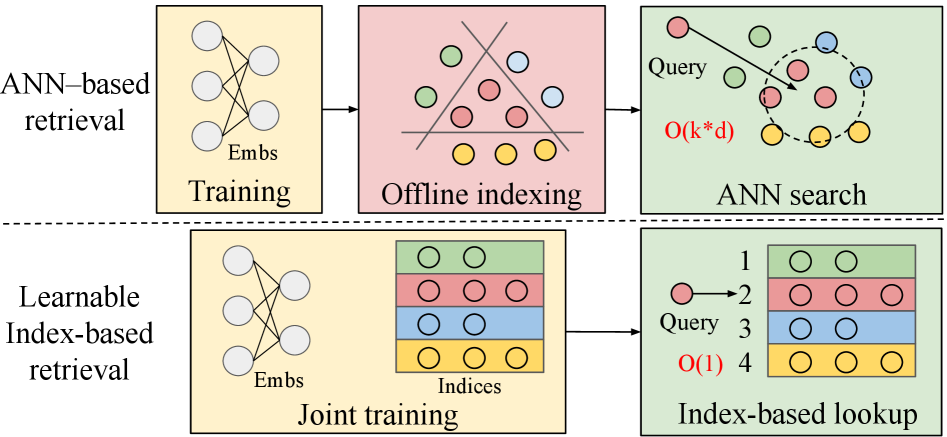
Figure 1: Compares the conventional three-stage ANN pipeline with jointly learning the index. From the original paper; copyright remains with the authors.
Core equations
For facet \(m\) and code \(c_m(i)\), the request dynamically allocates \(a_m(q)\):
Paper results
- Seven-day A/B: low-VV content impressions
+279%, mid-VV+54%, and head content-2%. - Ultra-fresh
+221%, same-day+10%, explicit interactions+0.08%, diversity+0.30%, and QPS+60%.
Local reproduction
Local comparison: Against a same-split single-space ANN proxy, four-facet MFLI gives NDCG@10
-10.01%.
Hit@10 is unchanged, NDCG@10 falls -10.01%, and head share rises +9.94%. Facet allocation on small public data does not reproduce the paper's move away from head content. This result is retained.
See the metrics.
Reproduction boundaries
Full-catalog scoring provides a fair experiment, not a test of Meta's billion-scale real-time index, GPU QPS, or private freshness labels.