ULTRA-HSTU: Bend the scaling curve for large recommenders
Core semi-local attention, LBSL and mixture of transducers.
Paper information
| Field | Details |
|---|---|
| Paper | Paper or original source |
| Institution | Meta. |
| First public release | 2026-02-19 (arXiv v1) |
| Author code | No official author code linked by the paper as checked on 2026-08-09. |
| Local adapter or method key | ultra-hstu |
| Local reproduction code | src/auto_research/reproductions/ultra_hstu/ |
Paper method and evidence
At 16k behaviors and greater depth, HSTU attention and memory bottleneck scaling. Use local tokens and sparse landmarks, widen windows by layer with LBSL, and combine a mixture of transducers with attention truncation, mixed precision and dynamic topology.
flowchart LR
  A[Local tokens and landmarks] --> B[Widen attention by depth]
  B[Widen attention by depth] --> C[Mix transducers]
Original paper figure
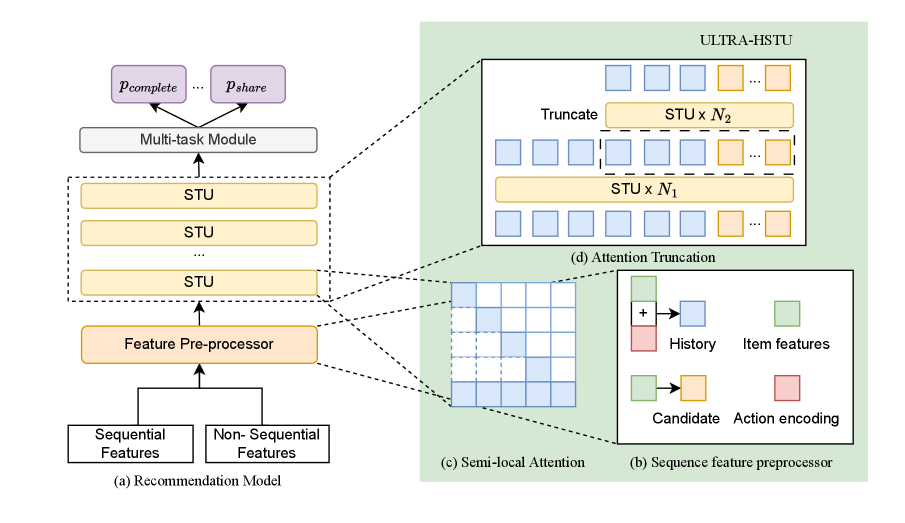
Figure shows the scalable HSTU architecture. From the original paper; copyright remains with the authors.
Core equation
Each layer attends only to its local window and block landmarks; LBSL widens the window with depth.
Reported results
Multiple 30-day A/B tests and full rollout to billions of daily users report consumption +4.11%, engagement +2% to +8%, topline +0.05%/+0.01%, training scaling efficiency 5× and inference 21×.
Local reproduction
Short-history transition/content control versus six layers, 8-token local windows and wider summaries: Hit@10 +8.33%, NDCG@10 -0.95%, fresh Hit@10 +50%, head share -13.38%. Seed-42 metrics. 48 events proxy 16k; no 18-layer production model, dynamic topology, FP8 kernel or private logs. No stable quality claim.