TubiFM: Unified Item, Carousel, and Search Ranking for Streaming Discovery
Core public-data unified ranking mechanism.
Paper information
| Field | Details |
|---|---|
| Paper | Paper or original source |
| Institution | Tubi. |
| First public release | 2026-05-22 (arXiv v1) |
| Author code | No official author code linked by the paper as checked on 2026-08-24. |
| Local adapter or method key | tubifm |
| Local reproduction code | src/auto_research/reproductions/tubifm/ |
Paper method and evidence
Represent cross-page journeys as a shared user story. Task prompts let the same generative foundation model rank items, carousels and search.
flowchart LR
  A[User story across surfaces] --> B[Task-conditioned foundation model]
  B[Task-conditioned foundation model] --> C[Item carousel and search rankings]
Original paper figure
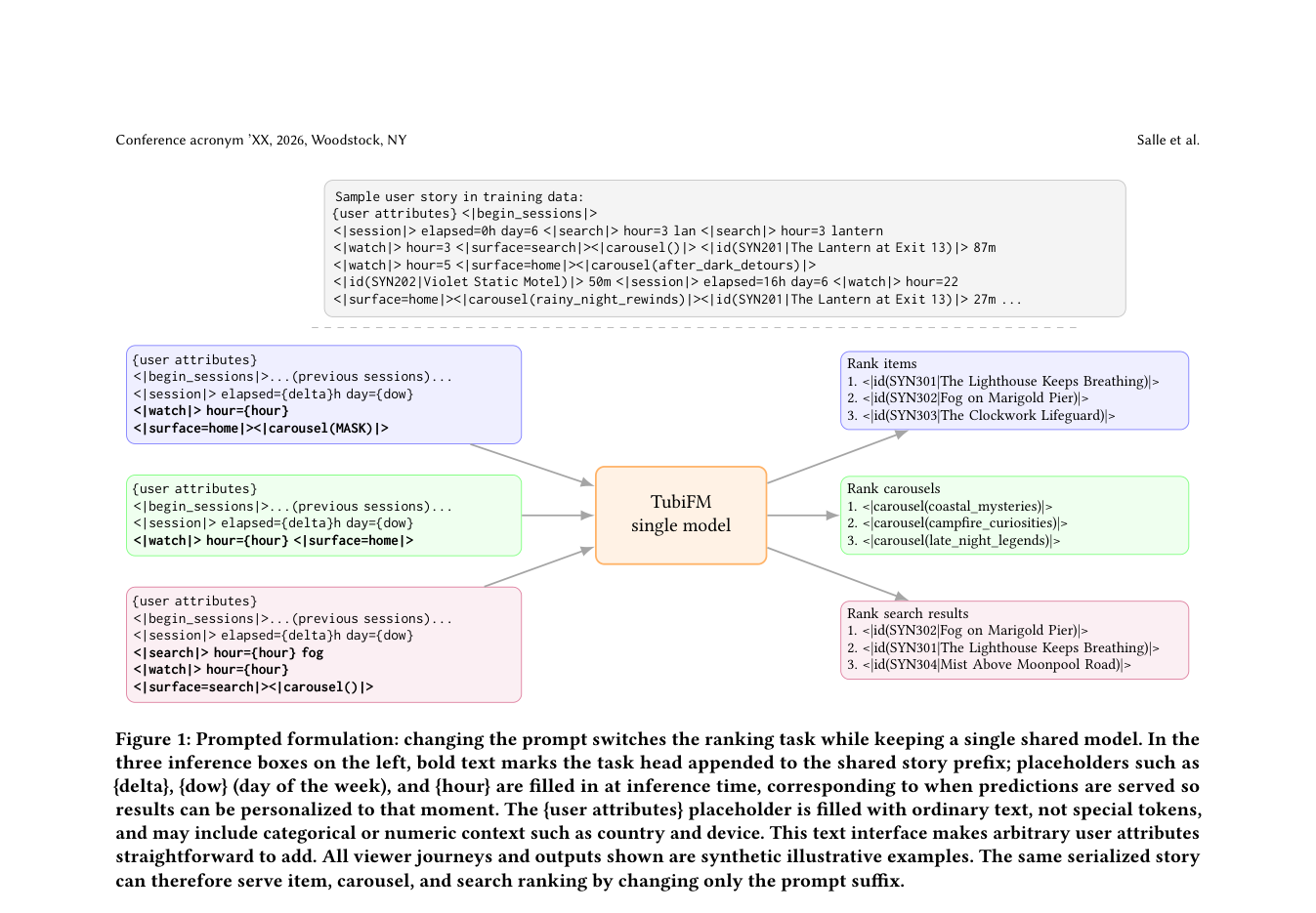
Figure shows the shared user story and task paths. From the original paper; copyright remains with the authors.
Core equation
\[
s(i|h,\tau)=\log p_\theta([ITEM=i]|\operatorname{serialize}(h,\tau))
\]
Reported results
Production A/B reports total viewing time +3.90%, p<0.05. Not comparable to MovieLens.
Local reproduction
Matched MovieLens-100K 220 users/360 items, full-catalog split and seed 42: shared transition+content baseline versus TubiFM. NDCG@10 0.0540→0.0543 (+0.45%), Hit@10 0.1091→0.1045. Validation chooses blend only; no test tuning. Fixed metrics. No private logs, traffic, checkpoints or production serving; local results do not reproduce paper lift.