RankGraph-2: Scalable Industrial Graph Retrieval
Core-mechanism reproduction. Popularity correction, offline PPR, and cluster indexing execute.
Paper information
| Field | Value |
|---|---|
| Paper | arXiv 2606.18379 |
| Affiliations | Meta |
| First public release | 2026-06-16 (arXiv v1) |
| Authors' code | No official author code linked as of 2026-08-09. |
| Adapter / method | rankgraph2 |
| Local code | src/auto_research/reproductions/rankgraph2/ |
Original paper
Background and contribution
Online multi-layer GNNs are costly and can overemphasize popular edges. Correct edge popularity, precompute multihop PPR, and compress serving with a jointly learned residual cluster index.
flowchart LR
  A[User-item graph] --> B[Corrected edges] --> C[Offline multihop PPR] --> D[Residual cluster index] --> E[Low-cost retrieval]
Key figure from the paper
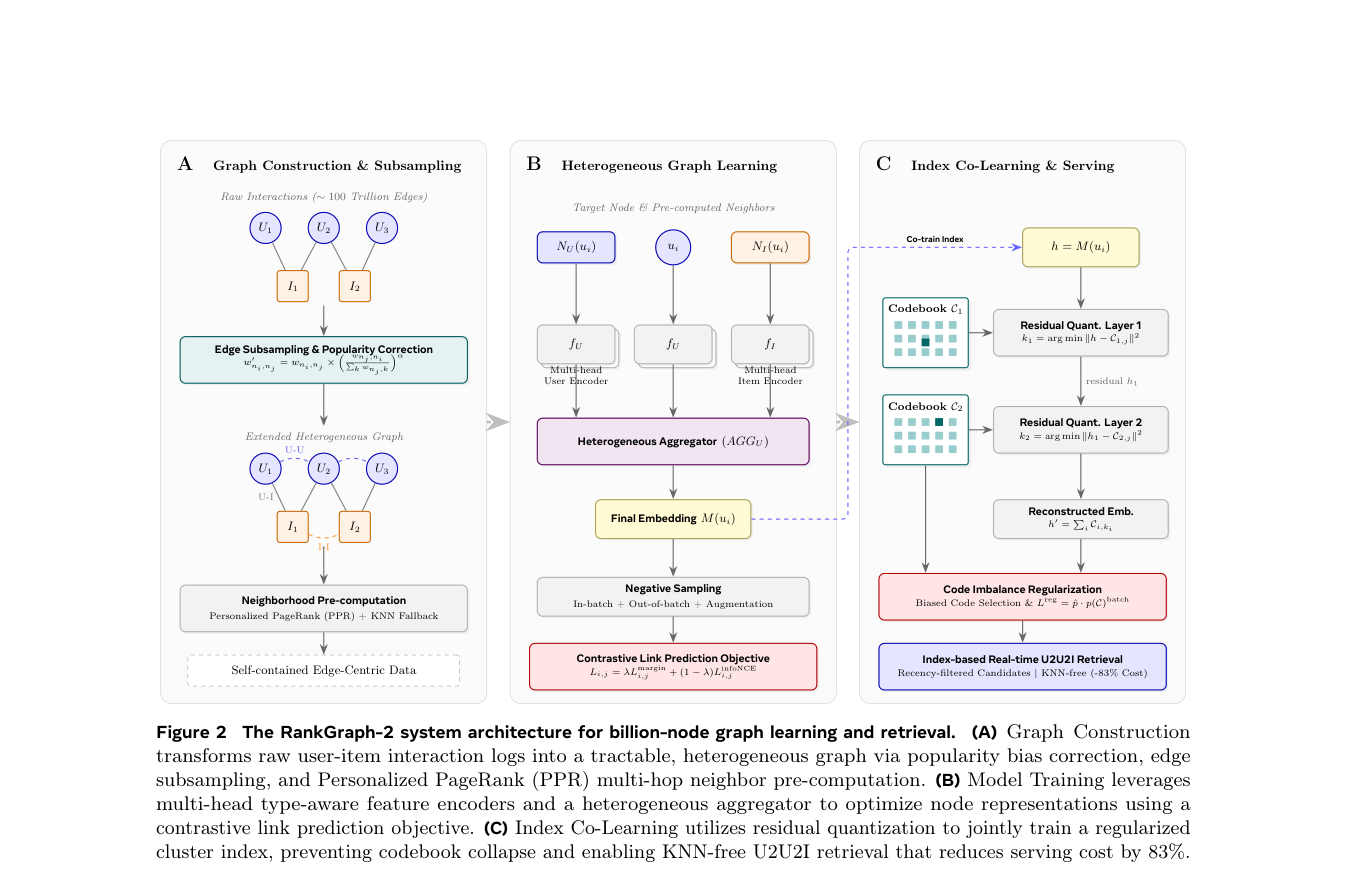
Original Figure 2: graph retrieval and serving. From the paper; copyright belongs to the authors. Not a local result.
Core mechanism
Paper results
The paper reports 83% less compute, 3.8×/2.1× recall, and production CTR +0.96%, CVR +2.75%, across more than 20 launches.
Local reproduction
On a MovieLens item graph, debiased transitions, multihop PPR, and PPR clustering run. Against one-hop retrieval, debiased PPR plus two-stage residual cluster indexing gives NDCG@10 0.03540→0.07421 (+109.65%), in metrics/movielens-100k-seed42.json.
Reproduction limits
MovieLens evidence is distinct from the paper's online results.