Dual-purpose Semantic IDs: Encode collaborative identity and content semantics together
Core SID learning, transitions and SiDec reconstruction/scoring.
Paper information
| Field | Details |
|---|---|
| Paper | Paper or original source |
| Institution | Google DeepMind / YouTube. |
| First public release | 2026-07-26 (arXiv v1) |
| Author code | No official author code linked by the paper as checked on 2026-08-09. |
| Local adapter or method key | dual-sid |
| Local reproduction code | src/auto_research/reproductions/dual_sid/ |
Paper method and evidence
Hierarchically quantized collaborative SIDs also reconstruct content via a Semantic Decoder (SiDec), so one token sequence supports generative retrieval, ranking and low-I/O online embedding reconstruction.
flowchart LR
  A[Learn hierarchical SIDs] --> B[Use collaborative transitions]
  B[Use collaborative transitions] --> C[Reconstruct content with SiDec]
Original paper figure
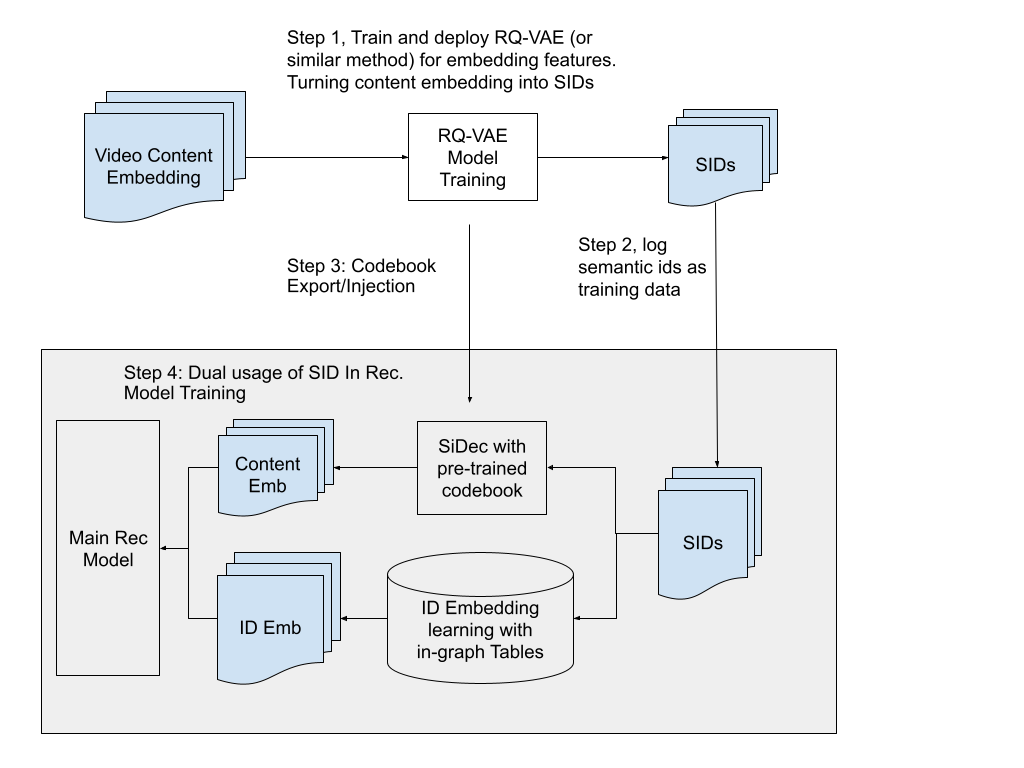
The original figure shows shared SID purposes. From the original paper; copyright remains with the authors.
Core equation
Let the hierarchical code be \(c(i)\) and decoder parameters be \(D\); optimize collaborative prediction and content reconstruction together.
Reported results
Watchpage ranking: sitewide +0.09%, watchpage +0.80%. Homepage ranking: sitewide +0.08%, homepage +0.22%. Retrieval: sitewide +0.06%, homepage +0.13%, watchpage +0.09%.
Local reproduction
Three levels of residual k-means with eight codes each; ridge SiDec reconstruction MSE 0.006760. Against same-split dense transition+content retrieval: Hit@10 -8.33%, NDCG@10 -12.40%, head share -7.65%. Small-codebook I/O proxy has a clear quality cost. Metrics. Genre proxies YouTube multimodal content; no large codebook, online reconstruction or private logs.