PSG: Shorten generative reranking with pair-space decoding
Core public-data pair decoding, not the production system.
Paper information
| Field | Details |
|---|---|
| Paper | Paper or original source |
| Institution | Kuaishou Technology. |
| First public release | 2026-07-29 (arXiv v1) |
| Author code | No official author code linked by the paper as checked on 2026-09-01. |
| Local adapter or method key | psg |
| Local reproduction code | src/auto_research/reproductions/psg/ |
Paper method and evidence
Encode adjacent items as request-local pair tokens. Generate a half-length pair sequence and expand losslessly. Ordered pair scores and duplicate constraints ensure usable slates.
flowchart LR
  A[Encode ordered item pairs] --> B[Generate shorter pair sequence]
  B[Generate shorter pair sequence] --> C[Expand to duplicate-free slate]
Original paper figure
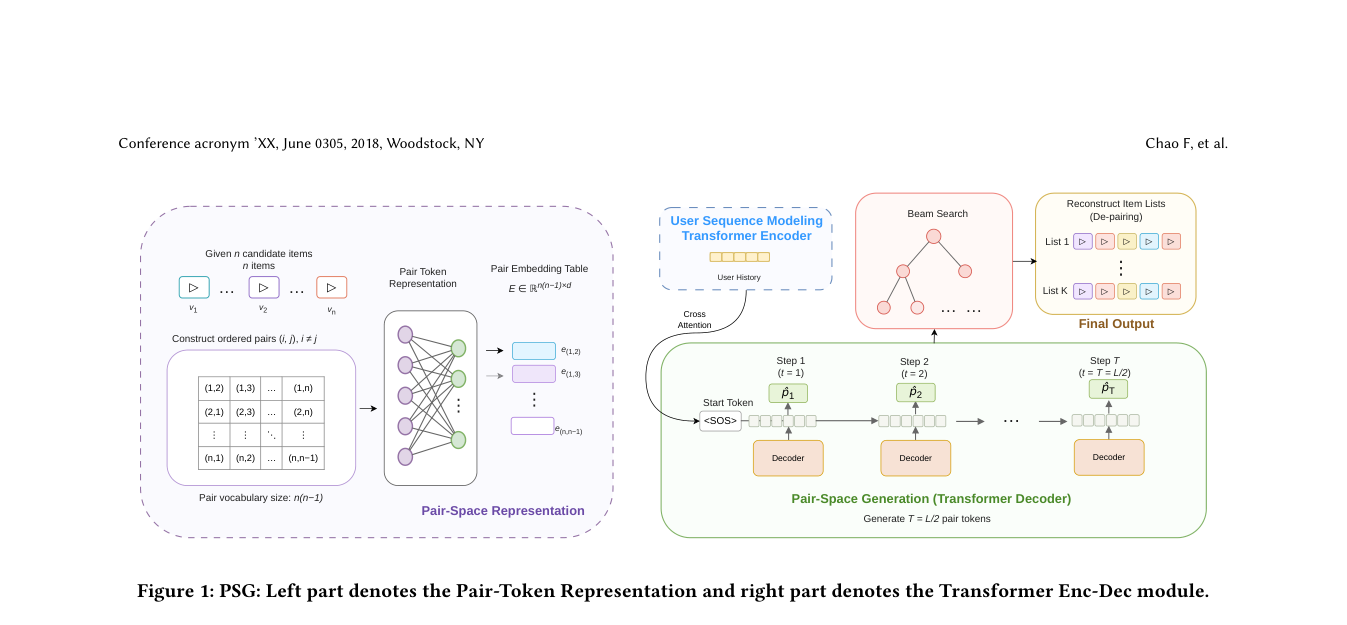
Figure shows pair generation and item expansion. From the original paper; copyright remains with the authors.
Core equation
Reported results
Two mutually exclusive 10% traffic buckets over seven days report dwell time +0.178%; industrial decoding speedup 1.83×.
Local reproduction
Six item-space steps vs three pair steps plus expansion. Seed 42 NDCG@10 0.05401→0.04826; retain the negative result. Three-seed metrics, mean, SD and 95% CI. Public MovieLens/proxy evidence does not establish production speed or lift. No private logs, traffic, checkpoints or production serving; local results do not reproduce paper lift.