简体中文 · English
ASARL
Fidelity: core-mechanism reproduction. Runs multi-agent data curation, SCT, preference optimization, and social distillation. Closed LLMs and private QQ logs are not reproduced.
Paper information
| Field | Details |
|---|---|
| Paper | arXiv 2607.26593 |
| Institution | Tencent PCG |
| First public release | 2026-07-29 (arXiv v1) |
| Author code | No official or author-released code found in the paper (checked 2026-08-09). |
| Local adapter or method key | asarl |
| Local reproduction code | src/auto_research/reproductions/asarl/ |
Original paper summary
Background and main changes
QQ group and channel search must handle colloquial titles, long-tail data, and behavior drift. ASARL uses ReasonAgent to produce intent–attribute reasoning and three-level relevance labels. CriticAgent repeatedly verifies labels and identifies coverage gaps, and GenAgent adds samples in the long tail. The pipeline then runs Social Context Training, Preference-Guided Optimization on interaction signals, and distillation into a small serving model.
flowchart LR
    L["Search logs and social attributes"] --> R["ReasonAgent"]
    R --> C["CriticAgent"]
    C -->|Feedback and relabeling| R
    C --> G["GenAgent fills long-tail gaps"]
    G --> S["SCT"]
    S --> P["PGO"]
    P --> D["Social Distillation"]
    D --> O["Online relevance model"]
Key figure from the paper
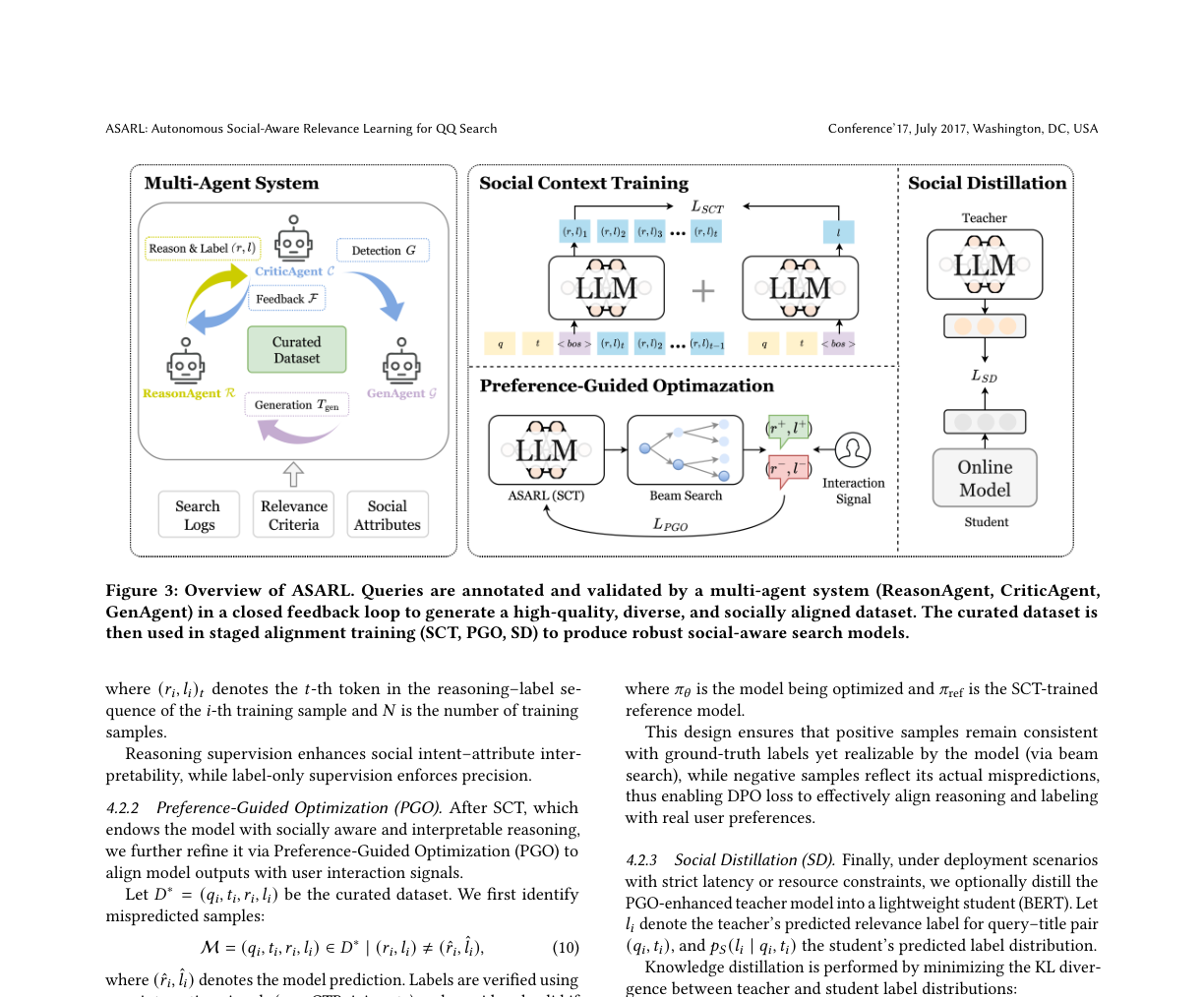
Image from the original paper, copyright the authors. Click for the source.
Core equations
PGO applies DPO to positive and negative reasoning-label sequences verified by behavioral signals:
and the serving student minimizes KL between teacher and student label distributions.
Offline and online results
- Distilled student versus the previous online RoBERTa: Macro-F1 65.01 → 72.05, NDCG@4 75.70 → 76.41, and accuracy 67.45 → 73.92.
- QQ's A/B platform allocated 20% each to treatment and control for at least 7 days. Channel search CTR, join rate, and GSB improved +2.69%, +2.59%, and +11.66%; group search improved +1.36%, +1.06%, and +16.66%, respectively. Deployment reached 12 million daily active users.
Local reproduction
Local comparison: Both arms use the same MovieLens relevance proxy, student parameter count, training split, and seed. The experimental arm adds Reason/Critic/Gen, PGO, and distillation. Relative NDCG@10 is −72.72%.
MovieLens-1M genre overlap proxies social attributes. The run executes Reason/Critic/Gen data curation, SCT three-way classification, preference margin, and teacher-to-student distillation. The control is a parameter-matched serving student trained only on original supervision.
At the fixed seed, NDCG@10 is 0.03598 for control and 0.00982 for ASARL proxy (−72.72%). Experimental classification loss falls from 1.1719 to 0.3295, but the proxy objective does not transfer to next-item ranking. See metrics/movielens-1m-seed42.json and the cross-domain summary.
Scope
The local run lacks private QQ query-title logs, production LLM labeling agents, and online RoBERTa. It verifies closed-loop curation, the preference stage, and distillation. The negative transfer with the MovieLens genre proxy remains as measured.