BaKron: Efficient Quantization with Kronecker-Factored Hessians
Core second-order quantization, not paper checkpoints or serving.
Paper information
| Field | Details |
|---|---|
| Paper | Paper or original source |
| Institution | University of California, San Diego. |
| First public release | 2026-08-06 (arXiv v1) |
| Author code | No official author code linked by the paper as checked on 2026-08-09. |
| Local adapter or method key | bakron |
| Local reproduction code | src/auto_research/reproductions/bakron/ |
Paper method and evidence
GPTQ usually uses input-side curvature. Bilateral Kronecker Hessians are richer but direct vectorized optimization is expensive; use anti-diagonal parallelism and recursive divide-and-conquer for adaptive rounding.
flowchart LR
  A[Factor Hessian on both sides] --> B[Parallelize anti-diagonals]
  B[Parallelize anti-diagonals] --> C[Round with recursive splitting]
Original paper figure
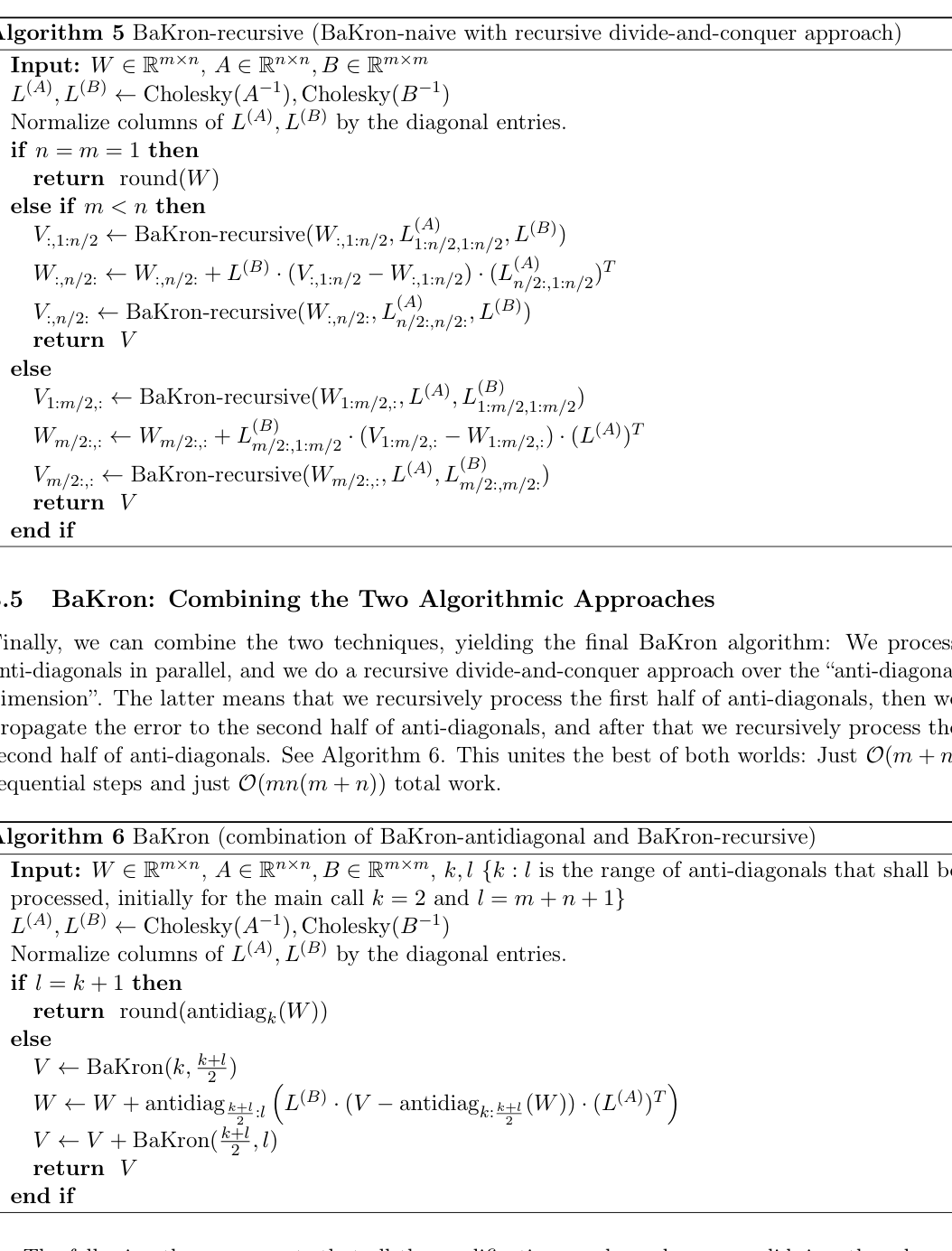
The original figure shows the accelerated rounding procedure. From the original paper; copyright remains with the authors.
Core equation
\(\min_{\hat W}\operatorname{vec}(W-\hat W)^\top(A\otimes B)\operatorname{vec}(W-\hat W)\).
Reported results
Sequential steps O(m+n); work O(m²n²)→O(mn(m+n)), matching GPTQ order while using bilateral curvature.
Local reproduction
On random weights run Kronecker-weighted 4-bit rounding and per-row scale search versus matched global GPTQ-style rounding. Metrics. No checkpoints, private features or production serving; cross-paper percentages do not apply. Executable structure candidates can be registered for Evolve; serving-only methods remain adapters, not trainable genomes.