GenRec: Netflix's LLM-based recommendation ranker
Fidelity: Core mechanism. The local run loads a causal LLM and executes LoRA Phase-2 post-training, textual user history, a full-catalog ranking head, joint language and ranking objectives, and reward-weighted loss. Netflix's private Phase-1 base and online reward models are unavailable and are not claimed to be reproduced by fixed rules.
Paper information
| Field | Value |
|---|---|
| Paper link | arXiv 2608.10257 |
| Organization | Netflix |
| First published | 2026-08-10 (arXiv v1) |
| Original author code | No author code or model checkpoint found as of 2026-08-13. |
| Adapter | genrec-netflix |
| Local reproduction code | src/auto_research/reproductions/genrec_netflix/ |
Original paper summary
Background and main changes
Conventional Netflix ranking depends on hand-designed features, feature interactions, and task-specific networks. A new content type or recommendation surface often needs new features, models, and infrastructure. GenRec shifts from feature engineering to context engineering: it represents user history, content metadata, device, and time as text, and lets a shared LLM learn semantics and higher-order interactions.
Phase 1 continues training an open LLM on Netflix content and user data to create an internal foundation model. Phase 2 post-trains it on more frequently refreshed ranking data, labels, and reward signals. The paper focuses on Phase 2.
- Textual context: Encode history, metadata, and request context in natural or lightly structured language. Filter events, compress sequences, and shorten descriptions to control token cost.
- Catalog-aware head: Pool a decoder-only LLM representation and score every item in one forward pass. The head cannot generate items outside the catalog.
- Joint objectives: Train ranking and next-token modeling together to retain text understanding and prompt steering.
- Reward-weighted ranking: Combine multiple reward models, including long-term satisfaction, content-type balance, and new-release stage, into example weights aligned to business goals.
- Prefill-only serving: Produce full-catalog scores after one prefill without token-by-token decoding.
flowchart LR
  H["User history, content, and request context"] --> V["Verbalization / context engineering"]
  V --> L["Netflix foundation LLM"]
  L --> P["Pooling hidden state"]
  P --> C["Catalog-aware ranking head"]
  C --> S["Full-catalog scores"]
  R["Long-term satisfaction and business rewards"] --> W["Reward-weighted ranking loss"]
  W --> L
  T["Language modeling loss"] --> L
Key figure from the paper
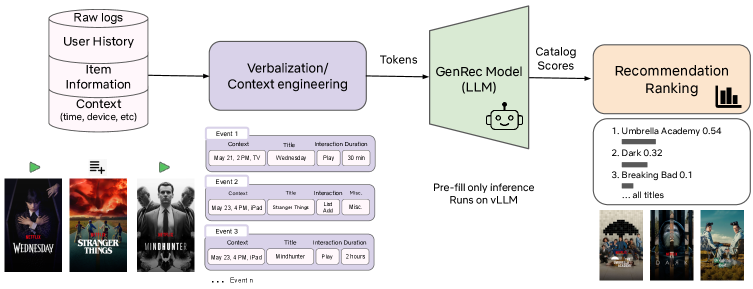
Original Figure 1 (architecture): Context engineering verbalizes interaction logs; a prefill-only vLLM pass scores the full catalog. Image from the original paper; copyright belongs to the authors. Click the image for its source.
Core equations
The verbalized input is:
The LLM yields pooled representation \(h\). The catalog head scores item vector \(e_i\) by \(s_i=\phi(h,e_i)\). The total objective is:
Combining rewards into example weight \(w_n\) gives the ranking loss:
Offline and online results in the paper
- Offline: approximately +1.6% MRR over the mature production ranker using roughly 1/40 of the labeled Phase-2 training examples and fewer signals.
- Phase 1: about +10% to 20% offline ranking improvement over using the open LLM directly.
- Phase 2: about +35% to 50% at the Phase-1 cutoff, rising to about 80% two weeks later due to freshness.
- Context: from approximately 5,000 to 1,700 tokens with little ranking-quality change; serving cost falls to about one-third.
- Online: around 10% of Netflix traffic for 4 weeks. Short-term home-page engagement +0.115%, \(P=3.1\times10^{-10}\); long-term core metric +0.006%, \(P=0.025\).
Local reproduction
Comparison
Control: An ID-only GRU discriminative ranker uses the same MovieLens slice, Phase-2 steps, and number of training examples. The GenRec variant uses a larger public causal LLM. This is a mechanism comparison between ID and LLM ranking, not a matched-parameter ablation. Single-seed NDCG@10 improves +35.07%, which is not directly comparable with Netflix's +1.6%.
The run uses time-ordered MovieLens-1M ratings of at least 3, 240 users, 500 items, seed 42, and 120 steps. It loads HuggingFaceTB/SmolLM2-135M and injects LoRA into q/v projections. Titles and genres form the text context. The catalog head ranks all 500 items. Every Phase-2 step combines language completion loss with novelty/content-discovery reward-weighted ranking loss.
| Local method | Hit@10 | NDCG@10 | MRR | Head share@10 |
|---|---|---|---|---|
| ID-only GRU baseline | 0.02500 | 0.01295 | 0.01873 | 0.08167 |
| GenRec LoRA + catalog head + reward weighting | 0.04167 | 0.01749 | 0.01973 | 0.06250 |
| Relative change | +66.67% | +35.07% | +5.35% | -23.47% |
This scaled public-data run uses a single seed and formal_comparison=false. It verifies trainability and the joint ranking/head-share behavior in this setting, not a reliable general gain.
pip install -e '.[plum]'
auto-research reproduce \
  --paper genrec-netflix \
  --dataset-dir data \
  --output-dir runs/genrec \
  --device auto \
  --seed 42
For a smaller CPU smoke test:
AUTO_RESEARCH_GENREC_USERS=40 \
AUTO_RESEARCH_GENREC_ITEMS=150 \
AUTO_RESEARCH_GENREC_STEPS=2 \
auto-research reproduce --paper genrec-netflix --dataset-dir data --device cpu --seed 42
See metrics/movielens1m-smollm2-seed42.json. Checkpoints, MovieLens data, and per-example predictions are not uploaded.
Reproduction limits
- The internal Phase-1 foundation model, thousands of production features, and hundreds of billions of interactions are unavailable. The local run uses public SmolLM2 and MovieLens text and feedback.
- The authors use long-term satisfaction and business reward models. The local run uses auditable popularity-based novelty and genre discovery weights.
- Netflix's vLLM cluster, production latency, batch-scoring surfaces, and online tests are not reproduced. The local run checks the semantics of full-catalog scoring after one prefill.
- No author code or checkpoints were released, so module-by-module numerical parity cannot be verified.