ReST: A recommendation-native sequence Transformer for industrial ranking
Public-data dual-gated temporal encoding and reusable user/candidate path.
Paper information
| Field | Details |
|---|---|
| Paper | arXiv 2609.01240 |
| Institution | ByteDance. |
| First public release | 2026-09-01 (arXiv v1) |
| Author code | No public author implementation found as of 2026-09-05. |
| Local adapter or method key | rest |
| Local reproduction code | src/auto_research/reproductions/rest/ |
Paper method and evidence
Dual-gated attention suppresses behavior noise. RoPE and relative time represent both order and elapsed time. A heavy user encoder runs once per request, then a light cross decoder scores each candidate.
flowchart LR
  H[Behavior history] --> U[Heavy dual-gated user encoder]
  U --> D[Reuse user state]
  C[Candidate] --> R[Light cross decoder]
  D --> R
Original paper figure
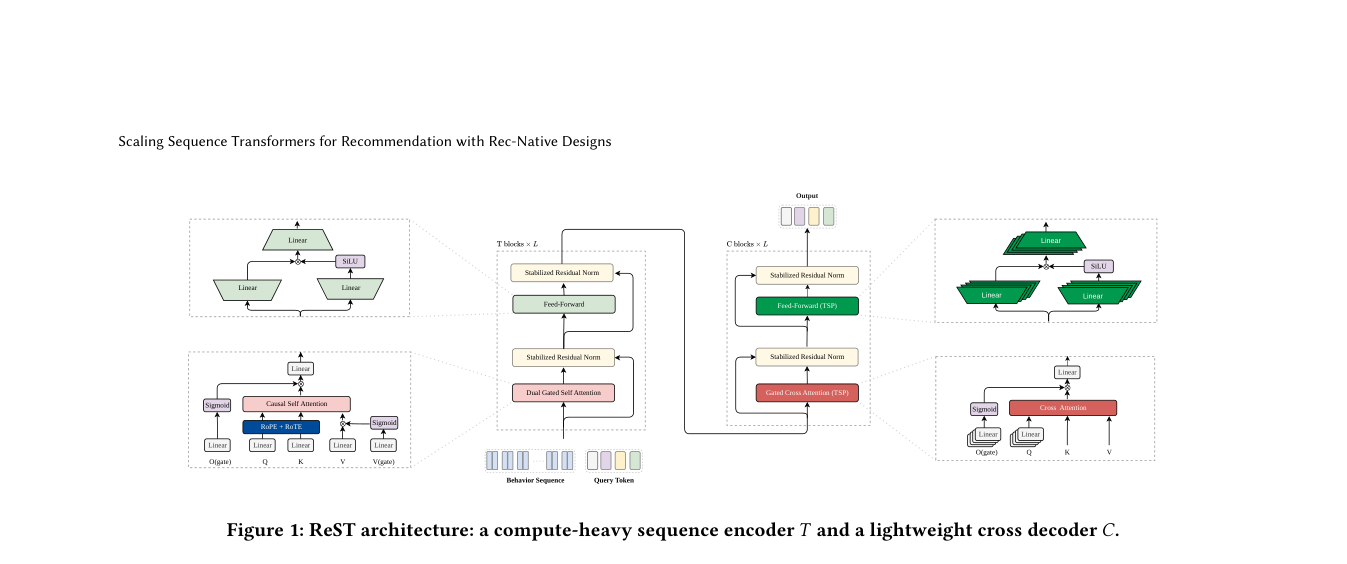
The original figure shows the compute-once, decode-many architecture. From the original paper; copyright remains with the authors.
Core equation
\(h_u=\mathrm{DualGate}(H)\) and \(s(u,i)=\mathrm{CrossDecode}(h_u,e_i)\); reuse \(h_u\) across the request.
Reported results
The one-week online A/B reports online AUC +1.31%, core revenue +11.93%, P99 50 ms, followed by full rollout.
Local reproduction
MovieLens-100K, fixed 220 users/360 items: temporal decay, signal gates and candidate crossing execute on CPU. NDCG@10 0.05401→0.05372 (-0.53%). Three-seed metrics. No private logs, production checkpoint, shared-prefix serving kernel or CUDA claim. The negative public-data result does not contradict or reproduce online lift.