Lngram v2: latent n-gram memory with interpretable discrete representations
Core mechanism plus real VLM checkpoint GPU validation. Implements multi-route discrete addressing, exact n-gram lookup, counterfactual surrogate gradients, and grouped-query readout with a zero sink.
Paper information
| Field | Details |
|---|---|
| Paper | ICLR 2027 |
| Organization | Beijing University of Posts and Telecommunications / Kuaishou Technology |
| First public release | 2026-09-03 (arXiv v1) |
| Authors' code | No public author code was found on 2026-09-06. |
| Adapter / method | lngram-v2 |
| Local reproduction code | src/auto_research/reproductions/lngram_v2/ |
Original paper
Motivation and method
Project backbone hidden states into several binary addresses and perform O(1) table lookup with the latest discrete unigram or bigram combination. Grouped-query attention reads multiple route tokens back into the backbone. Hard addresses are interpretable, neighboring counterfactual addresses provide gradients, and a zero sink allows the model to ignore unhelpful memory.
flowchart LR
  H[Backbone hidden state] --> R[Multi-route bit projection]
  R --> I[Hard discrete n-gram address]
  I --> M[Memory lookup]
  M --> G[GQA and zero sink]
  G --> O[Residual output]
Key figure from the paper
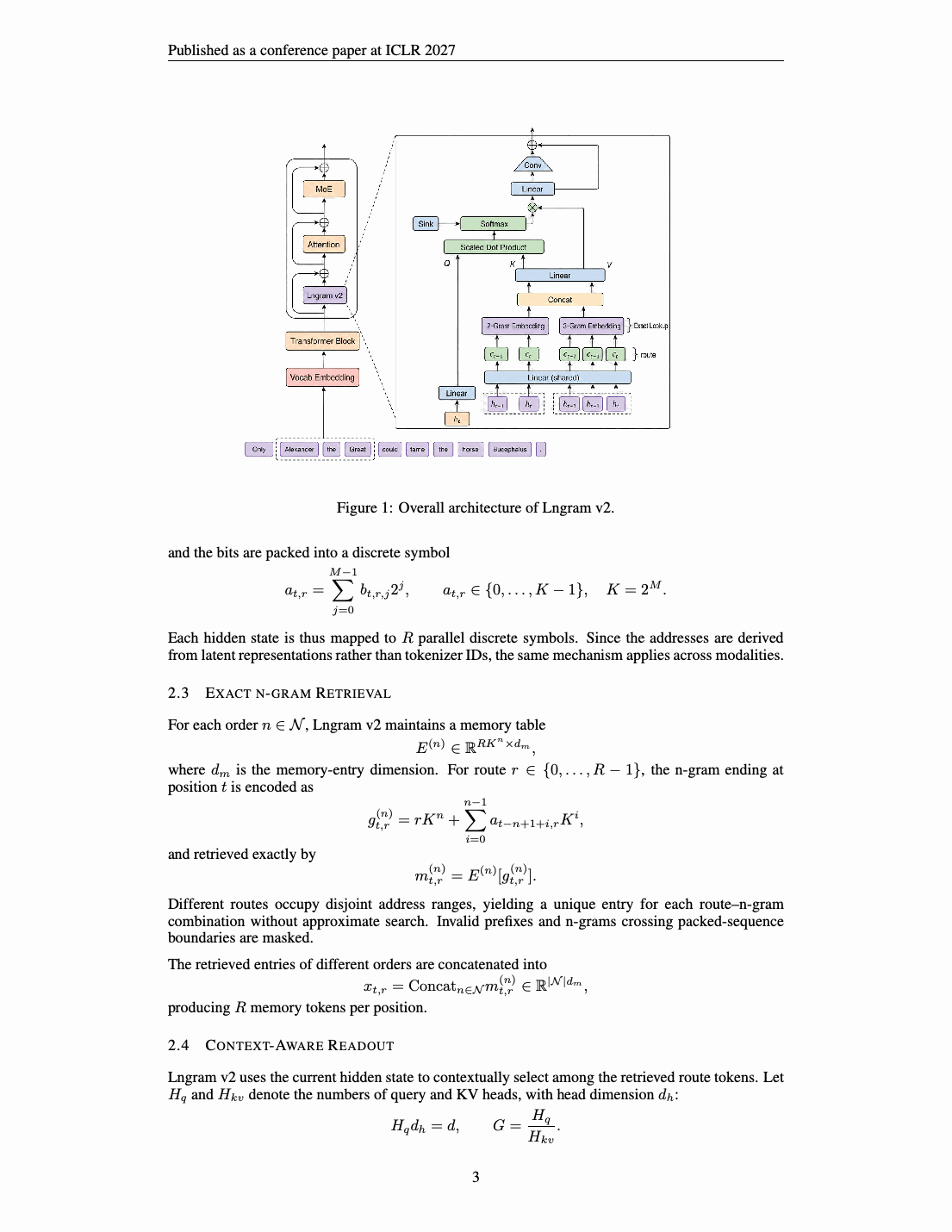
Key figure: Original model architecture and discrete-memory path. From the original paper; copyright remains with the authors.
Core equations
For route \(r\), the discrete address is \(z_t^r=\operatorname{bits}(W_rh_t)\); an order-\(n\) query uses \((z_{t-n+1}^r,\ldots,z_t^r)\). Retrieved tokens and the zero sink enter grouped-query attention and are written back as a residual.
Paper results
Relative to Lngram v1, total memory parameters decrease 82.6% and active parameters per token 95.2%. Semantic recovery from discrete IDs reaches 65.77%–84.27%. The paper validates Keye 2B/30B multimodal models.
Local reproduction and GPU evidence
See the three-seed CPU mechanism results and A100 backward-pass receipt using real SmolVLM2-256M-Video-Instruct multimodal hidden states.
Local comparison: The baseline is the original checkpoint without latent memory. The treatment checks the hidden-state mechanism and gradients only. There are no same-budget post-training task results, so relative gain is not applicable.
Reproduction boundaries
No full Keye 2B/30B pretraining or paper-scale corpus. GPU evidence covers execution, gradients, and memory feasibility on real public VLM hidden states. The mechanism can serve as an LLM or multimodal evolve memory operator.