Beyond Interaction Capacity: Estimator Scaling with Recursive Models for CTR Prediction
L1 mechanism diagnostic. Shared recursion, route averaging, trajectory EMA, and a runnable RankMixer Evolve block execute.
Paper information
| Field | Value |
|---|---|
| Paper | arXiv 2609.37905 |
| Affiliations | Georgia Institute of Technology / Google Research |
| First public release | 2026-09-29 (arXiv v1) |
| Authors' code | No public author repository found as of 2026-10-01. |
| Adapter / method | recap-ctr |
| Local code | src/auto_research/reproductions/recap_ctr/ |
Original paper
Background and contribution
Scale related estimators rather than only increasing the interaction capacity of one predictor. A shared recursive backbone generates routes, combined with independent-model distillation, training-trajectory EMA, and inference route averaging.
flowchart LR
  I[Input or state] --> R[Shared recursive routes] --> L[Route logits and EMA] --> O[Average output]
Key figure from the paper
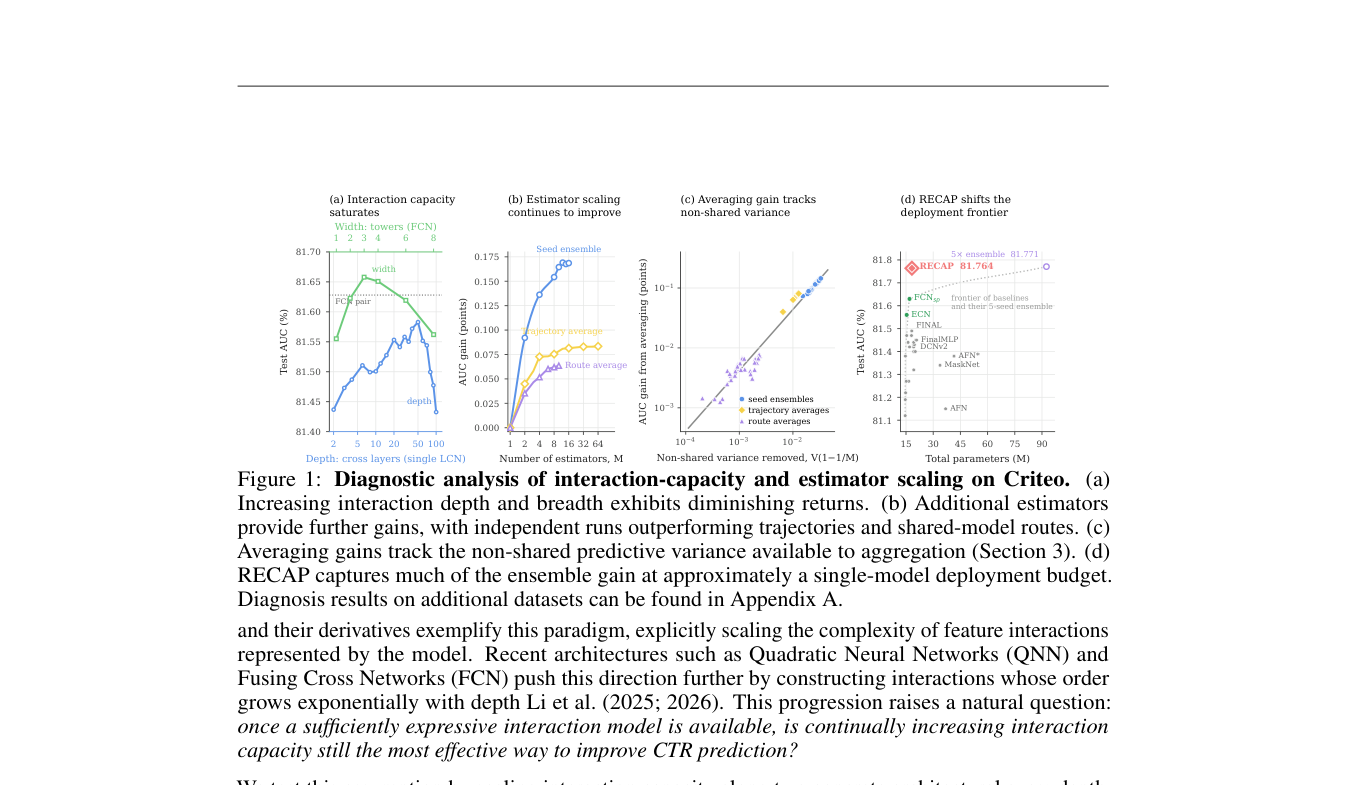
Original Figure 1: RECAP architecture. From the paper; copyright belongs to the authors. Not a local result.
Core mechanism
Average route logits as \(\bar Z_M=M^{-1}\sum_m Z_m\). A shared block recurs over routes and the implementation keeps training-trajectory EMA.
Paper results
The paper improves the performance–parameter Pareto frontier on public CTR benchmarks without quantified online A/B. This is an academic mechanism and Evolve operator, not production evidence.
Local reproduction
Compare disabled/default and enabled behavior. Three-seed diagnostics, diagnostic_only=true, check transitions, gradients, and invariants, not relative capability rankings.
Reproduction limits
The recursion, averaging, EMA, and runnable RankMixer block are supported; benchmark training and independent model distillation were not run.