Generative End-to-end Ad Retrieval at Douyin
L1 core-mechanism diagnostic. Runs BasisVQ, the prefix residual-quantization interface, and collision reranking. No streaming parameter server, minute-level index, or online traffic is reproduced; random tensors are not advertising outcomes.
Paper information
| Field | Details |
|---|---|
| Paper | Generative End-to-end Ad Retrieval at Douyin |
| Organization | ByteDance |
| First public release | 2026-09-30 (arXiv v1) |
| Authors' code | No public author implementation was found as of 2026-10-02. |
| Adapter / method | gear |
| Local reproduction code | src/auto_research/reproductions/gear/ |
Original paper
Motivation and method
GEAR parameterizes BasisVQ/BasisRQ with an orthogonal basis so codebook updates share structure globally and rotate stably. The generator outputs hierarchical tokens; a context-conditioned reranker ranks items with collisions.
flowchart LR
  I[Public input and current state] --> M[gear mechanism]
  M --> A[Auditable intermediates]
  A --> O[Output or state update]
Key figure from the paper
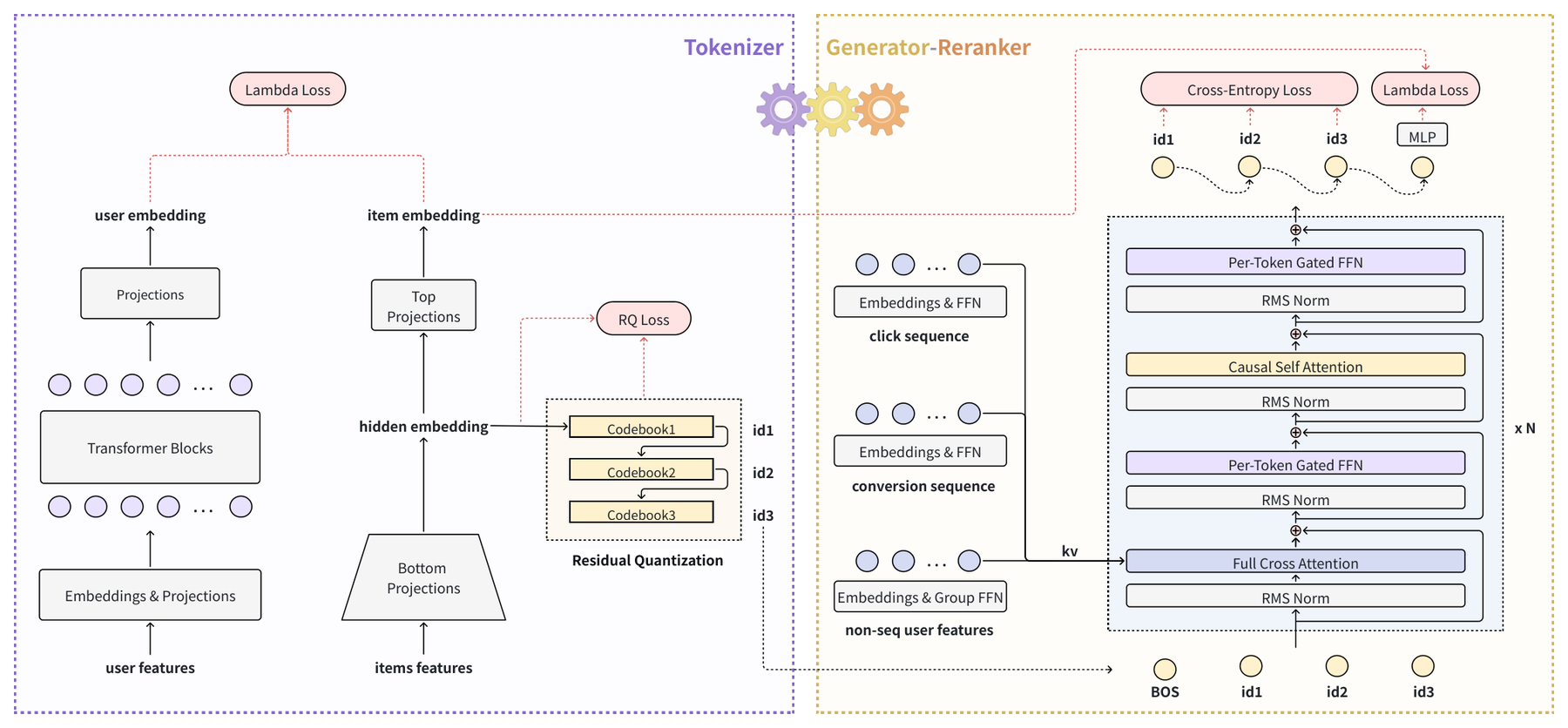
Key figure: Original architecture, training flow, or system protocol. From the original paper; copyright remains with the authors. Click the image for the source.
Core equations
\(q(z)=B c_{argmin_j\|zB-c_j\|}\). Within a collision group, rank by \(s_i=h_u^Te_i\).
Paper results
In a seven-day Douyin Ads online A/B test with 5% traffic per arm, ADSS rose 0.563%, ADVV rose 0.658%, and cold-start activation rose 1.46%.
Local reproduction
Local comparison: The baseline disables the mechanism or uses default state; the treatment enables the core operator. Relative percentage change is not applicable. This checks invariants, gradients, or state transitions, not paper-scale effects.
- Three-seed diagnostic
diagnostic_only=true; ineligible for formal capability ranking.
Reproduction boundaries
BasisVQ, prefix residual quantization, and collision reranking run locally. The streaming parameter server, minute-level index, and online traffic are not reproduced. Random tensors do not measure ad effectiveness.