Neither Black nor White: Balancing Semantic and Collaborative Signals with Graph-Informed Semantic IDs (GrIS)
L1 mechanism diagnostic. User-approved academic/Evolve exception on 2026-10-02; no online A/B or industrial evidence claim.
Paper information
| Field | Value |
|---|---|
| Paper | arXiv v1 |
| Affiliations | Huawei Ireland Research Centre |
| First public release | 2026-10-01 (arXiv v1) |
| Authors' code | graph-informed-sids |
| Adapter / method | gris |
| Local code | src/auto_research/reproductions/gris/ |
Original paper
Background and contribution
Build semantic IDs by hierarchical graph partitions. Nodes carry content semantics and edges collaboration. Empty graphs reduce to content quantization.
flowchart LR
  I[Content and graph] --> P[Graph-aware binary partitions] --> S[Semantic IDs]
Key figure from the paper
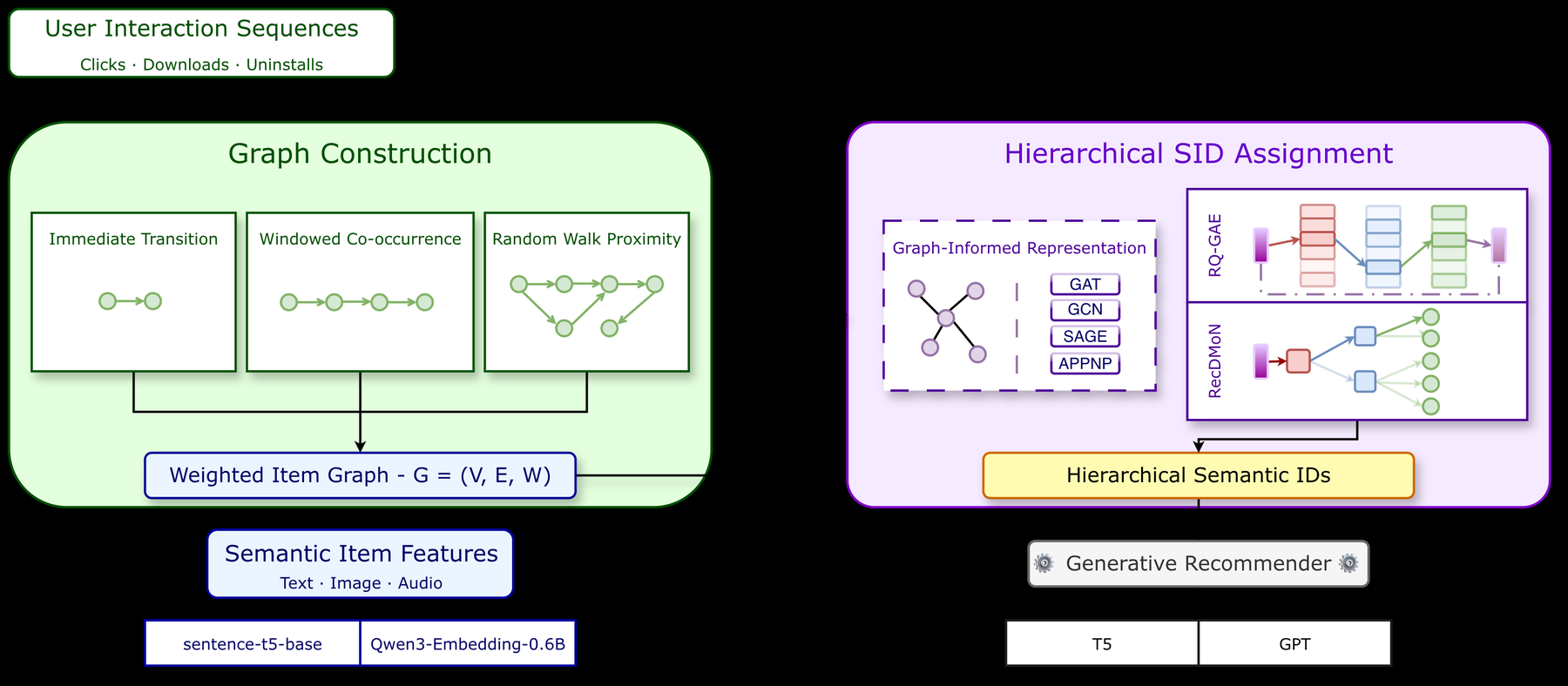
Original GrIS method figure. From the paper; copyright belongs to the authors. Not a local result.
Core mechanism
\(SID(i)=RecursivePartition(G,X)_i\). Each layer combines smoothed semantics and adjacency.
Paper results
Up to 52% higher Hit@10 than CF-aware state of the art across real datasets, as reported by the authors.
Local reproduction
Compare disabled/default versus enabled. Three-seed diagnostics verify transitions and invariants, not paper-scale effects (diagnostic_only=true).
Reproduction limits
The graph-informed binary hierarchy executes. The exception is not production A/B evidence.