WOVEN: Visual State Transitions as a Shared Training Primitive
Paper information
| Field | Value |
|---|---|
| Paper | arXiv 2610.12417 |
| Affiliations | Northwestern University / Carnegie Mellon University / UNC Chapel Hill / Amazon |
| First public release | 2026-10-08 (arXiv v1) |
| Authors' code | Yes: WOVEN |
| Adapter | woven |
| Local code | src/auto_research/reproductions/woven/ |
The authors released training code and train data on 2026-10-09. As of 2026-10-12, their public card marked validation and three test splits as pending upload. The catalog uses the paper's v1 date, not the code release date.
Original paper
Background and contribution
Static recognition is not understanding change. WOVEN uses \((s,a,s')\) as its common object, obtaining outcomes and intermediate states from video-model rollouts rather than writing outcomes into prompts. Different actions from the same initial state provide counterfactuals. Scene, action, and reasoning axes control supervision; typed distractors distinguish errors.
The mechanism is training a multimodal LM with actual visual-transition supervision, not an image scorer. The corpus contains 36,076 four-option questions, 20 scene types, 5 action types, and 8 operations: 22,728 train, 2,508 validation, 6,228 ID test, 3,496 scene-OOD, and 1,116 state-perturbation items. Supervision operation predicts transfer better than scene content, and change magnitude affects robustness.
flowchart LR
 A[Same initial visual state] --> B[Wan2.2 rollouts under different actions]
 B --> C[Actual outcome and intermediate frames]
 C --> D[Scene, action, and reasoning MCQs with typed distractors]
 D --> E[Actual multi-image VLM input]
 E --> F[Four option orders and response-only LoRA SFT]
 F --> G[ID, OOD, perturbation, and transfer evaluation]
The v1 PDF, page 5 Figure 2, confirms all three axes. Dashed boxes are inferred transition elements; restaurant/beach belong only to scene-OOD. This is not a local accuracy plot.
Key figure from the paper
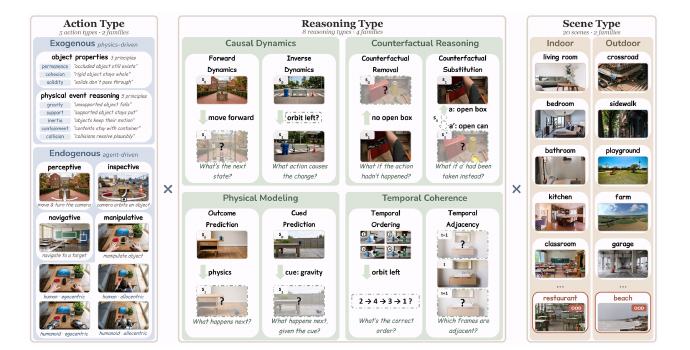
Original Figure 2, page 5 of the paper, showing the independent controlled axes and held-out scenes. Copyright belongs to the authors.
Core equations
Forward, inverse, and counterfactual operations use \(P(s'\mid s,a)\), \(P(a\mid s,s')\), and \(P(s'_{a_{alt}}\mid a,s',a_{alt})\). Temporal order and adjacency infer relationships between observed frames, not image classes. Local SFT preserves the response-only path:
The four option permutations move the target letter with its option, preserving content and image references. Original SFT uses LoRA rank 16/alpha 4/dropout .05, q/k/v/o projections, three epochs, and lr 1e-4. Full-mix uses SFT only; subset experiments add GRPO. See Section 2 and Appendix G.1. Local runs do not include GRPO.
Paper results
| Qwen2.5-VL-3B, Table 3 | Base | Full-train SFT |
|---|---|---|
| ID accuracy % | 26.4 | 89.3 |
| Held-out scene % | 27.8 | 88.2 |
| State perturbation % | 21.1 | 38.3 |
Controlled subsets of about 2,000 examples cover 22/26 external benchmarks with gains up to 27.3 pp. Different benchmarks use different subsets; this is not one model gaining on all 22. High ID scores do not establish robustness. See Sections 3–5. No production A/B was reported.
Local reproduction
Compare response SFT on real transitions with the same frozen public VLM at zero LoRA residual. The source-grouped small accuracy is L1, not an original benchmark comparison.
woven_prompt supplies questions, option labels/content, and actual images. answer is training target or post-hoc scoring only; is_correct/distractor_type/is_static/action_id stay out of the prompt. The processor reads real PIL images in order. Both vision encoder and autoregressive decoder run, not CLIP/class scoring.
PYTHONPATH=src python scripts/run_oct12_multimodal.py --paper woven \
  --device cuda --seed 42 --maximum 96 --steps 24 --lora-rank 16 \
  --dataset-dir data/oct12-woven --output runs/oct12/woven-s42
The default evaluates native option order; --evaluation-rotations 4 adds a circular diagnostic. Training cycles four arrangements. Steps and hyperparameters are fixed before test.
Data and results
Use MLL-Lab/WOVEN revision 9ebd698c8500f4d4729ffe39bd78f4fd694904aa, bounded public train prefix only. Split by initial-frame source_id; related actions/questions cannot cross partitions. Report item/group counts and hashes. Fewer than five groups fails rather than falling back to random-question splits. This is not official test or formal benchmark evidence.
Public SmolVLM-256M-Instruct, revision 7e3e67edbbed1bf9888184d9df282b700a323964, trains actual language q/k/v/o LoRA; visual encoder and base weights are frozen. scripts/prepare_oct12_public_sources.py --source woven streams the subset. Sync only woven.jsonl, images, and provenance.json; verify row/image/file SHA256s offline. --checkpoint-path selects a mirror without substituting the path for a public revision or exposing it in receipts.
On 2026-10-12 A100 ran a 96-item prefix split by source into 56/16/24 and trained 24 steps. Four orders per local test item gave 96 scores. Frozen accuracy was 0.28125; LoRA gave 0.27083. Retain the degradation. Test did not select the budget; this is neither official test nor evidence of transfer.
Measurements and group hashes and GPU receipt preserve provenance. Tests cover option/target remapping, image order, gold exclusion, and source isolation.
Code and boundaries
multimodal/oct12_reward_transition.py::{woven_prompt,LoRALinear,sft_response_loss,run_woven} implements the mechanism alongside the CLI and preparation scripts. It uses real images derived from author rollouts without regenerating Wan videos. It does not reproduce 3B/7B/32B, GRPO, 22,728-example training, or the 26 transfer benchmarks. Labels go only to trainer/evaluator, not candidate generation. A nonofficial small test remains diagnostic with additional seeds. No Evolve integration claimed.