UMRM: A multimodal reward model from frozen intermediate layers without preference annotations
Paper information
| Field | Details |
|---|---|
| Paper | arXiv 2610.12707 |
| Institutions | Massachusetts Institute of Technology / Cornell University / Scale AI / Harvard University |
| First public release | 2026-10-08 (arXiv v1) |
| Author code | No public source found as of 2026-10-12. |
| Local adapter | umrm |
| Local reproduction code | src/auto_research/reproductions/umrm/ |
| Evidence level | core_mechanism / L1; bounded A100 run using a real frozen VLM, not a CLIP scorer. |
Paper method and evidence
Preference pairs are expensive, and reward-benchmark ranking need not predict deployment selection utility. The authors freeze Qwen3-VL, pool only response tokens from an intermediate language layer, and train a bias-free linear reward head. Public captions are positives; negatives are single-span color/count/size/direction edits, tail splices, shuffled clauses, and cross-image captions. No human preferences are needed for these training pairs. Layer selection still uses a labeled development benchmark; bootstrapping still uses cheap verifier labels. Different negative samplers learn different reward directions, so caption perturbation accuracy is not policy hallucination detection. A second experiment generates the policy's own candidates, creates success/failure pairs with a verifier, and retrains the head. Deployment utility improved while reward-benchmark scores fell.
flowchart LR
 A[Image prompt and real caption] --> B[Caption perturbation mixture]
 A --> C[Frozen VLM intermediate language layer]
 B --> C
 C --> D[Pool response tokens only]
 D --> E[Bias-free head and all-pairs Bradley-Terry]
 E --> F[Choose layer on validation]
 G[Policy generates candidates from images] --> H[External cheap verifier]
 H --> I[Retrain head with within-prompt pairs]
 I --> J[Best-of-N utility on separate test candidates]
Original paper figure
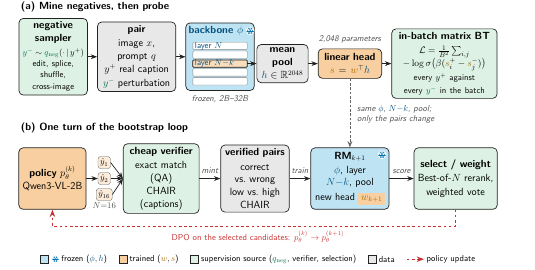
Figure 2, v1 PDF page 3 separates perturbation-to-probe and policy-generation-to-verifier bootstrapping. The backbone is frozen, the head is trainable, and test prompts omit reference objects and gold. Copyright remains with the authors.
Core equation
Use \(B=8,\beta=.1\) and all \(B^2\) chosen/rejected combinations, not just same-pair comparisons. Image/prompt features cannot enter the response pool. The external negative mixture \(q_{neg}=\sum_o\pi_oT_o(y^+)\) edits responses while holding images fixed, with near edit k1 and cross-image probability .15. Density-ratio arguments require additional assumptions; Section 2 discusses within-entry dependence and length artifacts.
Reported results
A 32B probe exceeded GPT-4o by 6.6 percentage points on VL-RewardBench; the 2B head has 2,048 parameters, and intermediate-layer selection gained 5.8 points over the final layer. Cheap-verifier bootstrapping reduced caption CHAIRs by 5.1 points versus greedy (95% CI -7.1 to -3.1), and 8B image-generation verifier pass rate rose by 5.4 points versus random. However, VL-RB fell from .679 for the mined probe to .615 for the verified head. See Section 3.4 and Tables 7–8. These are offline Best-of-N results, not production A/B.
Local reproduction
Compare a zero bias-free head (ties count half) with the actual intermediate head selected on validation; compare bootstrapping separately against random selection over own-policy candidates. SmolVLM encodes real images; a precise response mask controls pooling. Only the linear head updates. Perturbation counts and fallback edits are retained. Clause shuffles and cross-image captions are not guaranteed false; this is a sampler diagnostic. Exclude embeddings and final layer from candidates; train each head then choose on validation, never test.
PYTHONPATH=src python scripts/run_oct12_multimodal.py --paper umrm \
  --device cuda --seed 42 --maximum 80 --steps 200 \
  --bootstrap-prompts 8 --bootstrap-candidates 4 \
  --dataset-dir data/oct12-coco --output runs/oct12/umrm-s42
Use a bounded validation prefix from the public COCO-Caption2017 mirror, revision 3bdd5827e243cc3084ac69a1111e69c3ab9193ff, split by image ID into local train/validation/test. This is not an official reward benchmark. Captions, negatives, and own-policy candidates stay within split; save exact counts and item/group SHA-256. The public SmolVLM-256M-Instruct checkpoint is pinned at 7e3e67edbbed1bf9888184d9df282b700a323964. scripts/prepare_oct12_public_sources.py --source coco exports hashed JSONL/images/rows; --source smolvlm prepares the checkpoint and --checkpoint-path verifies its input file hashes.
Bootstrapping prompts include only the image and a request for one accurate sentence. After generation, the verifier checks objects against a COCO lexicon supported by public captions. This is not official CHAIR or a general visual-truth judge: captions and aliases can be incomplete. Object-free candidates abstain. With no real score difference, record verified_pairs=0/head_retrained=false rather than making a pair. Report bootstrap supervision separately from caption perturbations.
Measured A100 results
On 2026-10-12, one A100 used 40 COCO images (24/8/8), trained frozen-SmolVLM heads for 200 steps, and chose layer 10 on validation. Pair accuracy on eight synthetic-negative test items was 1.0 versus 0.5 for a tied zero head. This is saturation on a limited set, not general reward ability. Eight training prompts generated four candidates each, producing six verified pairs and two abstentions; the head was genuinely retrained. On separate test Best-of-N candidates, the caption-supported object scores were 0.58333 for the probe and 0.48611 for both verified head and random. No gain from bootstrapping; not CHAIR. Metrics and GPU receipt.
Code and limits
multimodal/oct12_reward_transition.py::{response_features,mean_response_states,in_batch_bt,train_reward_head,select_probe_layer} implements the frozen probe; caption_negative is the sampler; generate_candidates,mint_verified_pair,run_umrm provide independent policy/verifier/bootstrap and isolated test selection. Smaller CLI budgets and more seeds do not raise evidence level. No Qwen3-VL2B–32B, author 22K bank, annotated development benchmark, three official reward benchmarks, CHAIR, image generation, or DPO actor was reproduced. Retain negative and no-pair cases; test never selects the negative recipe. Scorer access to gold is not agent capability. No Evolve integration is claimed.