When Faster Decisions Do Not Make Better Agents: An Empirical Study of Jev in Agent Workflows
This is a core_mechanism / L1 diagnostic interface. It does not reproduce the paper's capability evaluation and is not eligible for promotion in Evolve.
Paper information
| Field | Value |
|---|---|
| Paper | arXiv 2610.13092 |
| Affiliations | Nanjing University / Technical University of Munich |
| First public release | 2026-10-09 (arXiv v1) |
| Author code | No verified release. The authors provided an anonymous experiment-code link, but only its frontend loaded; the API timed out, so usable source was not verified (2026-10-12). |
| Adapter | jev-workflow |
| Local implementation | src/auto_research/reproductions/jev_workflow/ |
Original paper
Background and contribution
This is an evaluation study, not a new self-improvement algorithm. It compares decision latency and cost with successful end-to-end delivery. Recovery failures, premature completion, and resources spent on unsuccessful attempts all affect the resources per delivered success; a faster individual decision is not enough. See the full paper.
Evaluation workflow
graph LR
 A[Execute both configurations on the same task/run] --> B[Verify delivery externally]
 A --> C[Decision and total latency/cost]
 A --> D[Failed recovery and premature completion]
 B --> E[Resources across all attempts per success]
 C --> E
 D --> E
 B --> F[Matched-success subset]
Redrawn diagram: architecture.mmd. The original Figure 2 shows the original protocol; the redraw does not substitute for it as evidence. See source-provenance.json for provenance and verification limits.

Key figure from the paper
Original Figure 2: The main experimental design and its components. From the paper; copyright belongs to the authors.
Core equations
\(Cost_{success}=\sum_iCost_i/\sum_i1\{success_i\}\), \(Time_{success}=\sum_iTime_i/\sum_i1\{success_i\}\), and \(FailureCostShare=\sum_{i:fail}Cost_i/\sum_iCost_i\). Matched-success comparisons only include pairs in which both configurations succeeded on the same task/run. They are reported separately from delivery over all attempts.
Paper results
| Metric | Paper result | Comparison or protocol |
|---|---|---|
| Total executions | 4500 | ALFWorld/AndroidWorld, three repetitions per configuration |
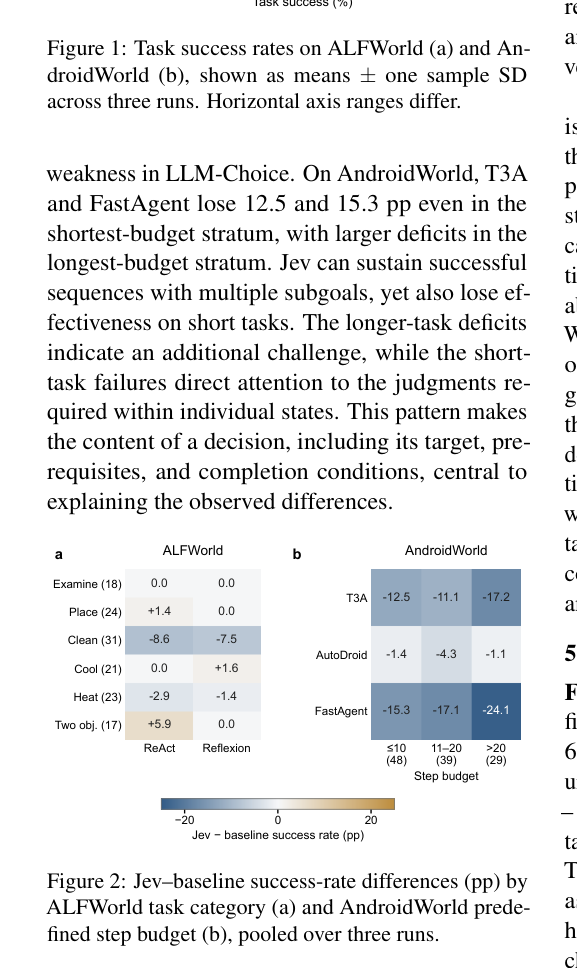
| T3A cost per delivered success, base/Jev | 68.70 / 73.97 mUSD | +7.7%; the 95% interval includes zero |
| FastAgent time per delivered success, base/Jev | 239.4 / 377.8 seconds | Lower success rates offset the per-step savings |
These are results from the paper, not local measurements. No production A/B test was reported. Do not compare results directly across different models, datasets, scoring rules, or resource protocols. The verified extract is excluded from local metrics and the dashboard.
Local reproduction
Local comparison: Pair the original configuration with the replacement decision configuration on the same task/run. The local implementation executes the experiment arm; there is no formal capability comparison or claim of a stable relative gain.
The implementation is in src/auto_research/agent_research/oct12_memory_tools.py. A thin adapter reads explicit settings from oct12.json and supplies neither fixed default candidates nor gold answers.
PYTHONPATH=src python scripts/run_oct12_agents.py \
  --method jev-workflow --device cpu \
  --dataset /path/to/public/input --seed 42 --rounds 2 --group-size 2 --train-steps 2 \
  --output runs/oct12/jev-workflow/result.json
Input protocol and implementation
The input is JSONL from actual paired workflow executions. Candidate and hyperparameter promotion use validation only; test data are isolated from training, and gold labels go only to an external scorer. The short run reports diagnostic_only=true, capability_comparison=false, and evolve_promotion_eligible=false. JSONL fields include task_id, run_id, configuration, success, decision_seconds, task_seconds, inference_cost, failed_recovery, and premature_completion. They must come from actual execution records; human annotations retain provenance.
Validation and limitations
This is executable paired-trace evaluation infrastructure. It neither loads nor simulates Jev weights or APIs and does not register paper tables as local runs. The two configurations must have complete task/run pairing and finite, nonnegative resources. Per-success quantities are null when there are no successes. The anonymous code page loaded only a frontend shell during the review, so runnable upstream source remains unverified.
In addition to the CPU aggregator, the measurement script freezes a byte-verified public SmolLM2-135M-Instruct checkpoint. It compares generation budgets of 64 and 256 on the same public 26-circle task, paired across seeds 42/43/44. It resets Python, NumPy, torch, and CUDA random state for every attempt, alternates execution order, and records synchronized generation time, total sandbox time, and exact generated token counts without updating weights.
PYTHONPATH=src python scripts/run_oct12_workflow_measurement.py \
  --checkpoint checkpoints/smollm2-135m-instruct \
  --checkpoint-id HuggingFaceTB/SmolLM2-135M-Instruct \
  --revision 12fd25f77366fa6b3b4b768ec3050bf629380bac \
  --device cuda --seeds 42,43,44 --budgets 64,256 --output runs/workflow-measured
PYTHONPATH=src python scripts/run_oct12_agents.py --method jev-workflow \
  --dataset runs/workflow-measured/pairs.jsonl --output runs/workflow-audit.json
On 2026-10-12, none of the six real A100 generations delivered a valid geometry solution. Both budgets had zero successes; mean total times were 2.71459 s and 10.01093 s, respectively. Cost and time per success were both null, so faster generation does not establish a better agent. Cost is measured in generated token units, not dollars. The one-shot workflow has no recovery or completion declaration. Its failed_recovery and premature_completion fields are explicitly N/A schema placeholders, not measured zeros.
See the measured results and the CUDA receipt. The CPU aggregator still does not require CUDA. The receipt verifies the measurement infrastructure, not the Jev model or the paper's 4500 agent runs.
Tests: python -m pytest tests/test_oct12_agent_algorithms.py tests/test_oct12_agent_delivery.py.