MSAR: Multi-stream attention residuals across depth
Paper information
| Field | Value |
|---|---|
| Paper | arXiv 2610.13630 |
| Affiliations | Shanghai Jiao Tong University / Shanghai Innovation Institute / Xiaohongshu / Peking University |
| First public release | 2026-10-09 (arXiv v1) |
| Author code | The author-provided repository returned 404 on 2026-10-12; no usable author source was found. |
| Adapter | msar |
| Local implementation | src/auto_research/reproductions/msar/ |
Local evidence is core_mechanism / L1. Actual A100 validation for three seeds is separate from paper-reported numbers.
Original paper
Motivation and method
Standard residuals compress earlier updates into one accumulated vector. AttnRes retrieves by layer but uses one depth-attention stream. MSAR retains each complete hidden vector, creates full-dimensional views at multiple scales using sequence context, and applies a separate depth softmax for each stream. Unlike channel-splitting heads, it does not split the value representation.
Block MSAR persists only the embedding, single-stream summaries of completed blocks, and the current block's partial sum. Views are expanded when consumed, not written back persistently. Causal convolution kernels of sizes 4/8/12 and an identity stream make four streams. An input-dependent sigmoid scalar mixer reduces the retrieved views to one stream.
flowchart LR
  A[Embedding and single-stream block summaries] --> B[On-demand identity and causal depthwise convolutions 4/8/12]
  C[Current block partial sum] --> B
  B --> D[Independent RMSNorm and depth softmax per stream]
  D --> E[Full-dimensional retrieved streams]
  E --> F[Input-dependent sigmoid H-pre mixing]
  F --> G[Actual attention or SwiGLU branch]
  G --> C
  C --> H[Single-stream summary at block completion]
  H --> A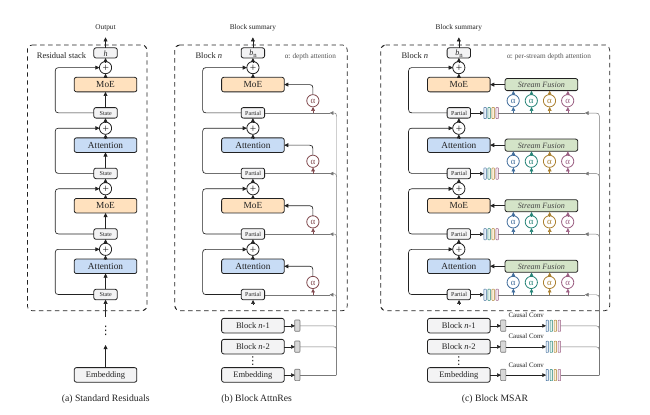
Figure 2 on page 7 of the v1 PDF confirms convolution after the single-stream summary, retrieval over the current partial sum, and no next expansion at the top layer. The authors' image is separate from the local redraw and is not a local run curve.
Core equations
Each view of source \(v_i\) retains the full \(d\) dimensions:
Depth retrieval and lightweight fusion are:
The final mixer uses sigmoid, not a stream softmax; depth weights within each stream sum to one. A block summary is \(b_n=\sum_{j\in B_n}f_j(h_j)\). The first branch has no partial sum; adding a zero source would change the softmax denominator. See Sections 3.2–3.3.
Paper-reported results
| Setting | Vanilla | AttnRes | MSAR |
|---|---|---|---|
| 18B MoE, 12-task mean, Table 1 | 37.5 | 41.8 | 45.7 |
| 28B MoE, 12-task mean, Table 1 | 44.6 | 49.4 | 52.4 |
| Iso-loss compute speedup relative to Vanilla | 1.00× | 1.35× | 1.58× |
At 28B the authors report 0.3% more active parameters and 0.5% more training FLOPs. These are the paper's large-scale experiments. No online A/B is reported; offline pretraining does not imply a production traffic lift.
Local reproduction
The control is a matched, real dense causal Transformer; the intervention is MSAR. This is a mechanism diagnostic, not an estimate of a stable relative gain from a few steps or a single seed.
Actual trainable autoregressive attention and SwiGLU execute, without substituting a Markov transition, fixed prior, or numerical fixture for the model. WikiText-2 official train/validation/test remain separate, and the UTF-8 byte vocabulary is fixed at 256 without fitting on test. Both arms default to width 64, 2 layers, 40 steps, and identical train batches. Only single-stream summaries persist; expanded views are consumed for the current read.
PYTHONPATH=src python scripts/run_oct12_foundation.py --paper msar \
  --device cuda --seed 42 --steps 40 --width 64 --layers 2 \
  --sequence-length 64 --train-bytes 32768 --eval-bytes 4096 \
  --dataset-dir data/oct12-wikitext --output runs/oct12/msar-s42
Data protocol and offline mirror
The data is Salesforce/wikitext, revision b08601e04326c79dfdd32d625aee71d232d685c3, configuration wikitext-2-raw-v1. Byte counts and SHA256 values for each split are recorded. The budget is fixed; test does not select depth, steps, or hyperparameters.
scripts/prepare_oct12_public_sources.py --source wikitext exports a small official mirror. The mirror must contain provenance.json and hashes covering all three text files. Identity, version, and bytes are checked; unrelated historical data is not relabeled as that revision.
Measured results
A100 runs on 2026-10-12 used seeds 42/43/44, 40 steps per arm, width 64 and 2 layers. Test byte NLL was 3.23254 ± 0.01263 for the baseline and 3.20308 ± 0.01081 for MSAR (mean ± sample standard deviation). Parameter counts were 180,544 and 190,292 respectively, so steps but not parameter counts matched. The 32 KiB train and 4 KiB validation/test prefixes are mechanism diagnostics, not reproduction of large-model gains.
See metrics and the sanitized GPU receipt. Budget and splits were fixed in advance; test was not used for selection.
Code mapping and limits
| Mechanism | Code |
|---|---|
| Causal multiscale full-dimensional views | foundation_models/oct12_mechanisms.py::SourceExpansion |
| Depth softmax and sigmoid fusion | DepthRead |
| Single-stream block summaries and real LM training | MSARLM, reproductions/oct12_foundation_multimodal.py |
| Interface, causality, and gradient tests | tests/test_oct12_foundation_mechanisms.py |
The original MoE, trillions of tokens, pipeline communication, two-phase batch reads, and fused CUDA kernels are not reproduced. The reference implementation preserves the mechanism but does not substantiate paper FLOPs, throughput, or 18B/28B benchmarks. The mini-LM was initialized from scratch, not with public pretrained author weights. No Evolve operator is claimed without actual controller execution.