PLE: Progressive extraction of shared and task-specific information
Actual shared/task-specific experts, CGC gates and separate heads; not Tencent Video scale.
Paper information
| Field | Details |
|---|---|
| Paper | RecSys 2020 paper |
| Institution | Tencent. |
| First public release | 2020-09-22 (ACM RecSys 2020) |
| Author code | No official author code linked by the paper as checked on 2026-08-09. |
| Local adapter or method key | ple |
| Local reproduction code | src/auto_research/reproductions/ple/ |
Paper method and evidence
MMoE shares all experts across tasks, which can entangle common and conflicting signals. PLE splits shared and task-specific groups; layered CGC gates progressively extract both kinds of information and reduce seesaw effects.
flowchart LR
  X[Shared input] --> E[Shared and task-specific experts]
  E --> G[Task-specific CGC gates]
  G --> H[Separate task heads]
Original paper figure
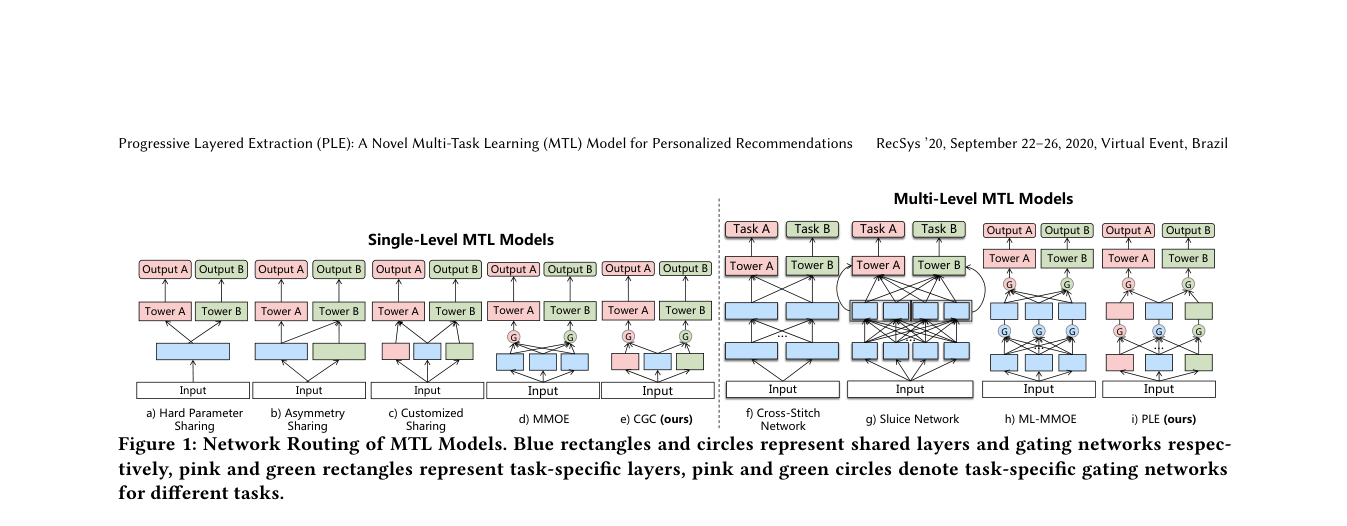
The original figure shows progressive extraction. From the original paper; copyright remains with the authors.
Core equation
Reported results
The paper reports outperforming MMoE on public and Tencent Video tasks and describes deployment. Included as a user-approved classic exception.
Local reproduction
MovieLens-100K two-task entire-space protocol. Compare matched MMoE with two task-specific groups plus shared experts; each task gates only its own group and the shared group. Three-seed mean task AUC +1.34%; CTR 0.56882→0.57982, conversion 0.56009→0.56418. Metrics. Run auto-research reproduce --paper ple --dataset-dir data.