Jev multi-correct choices: Auditing probability allocation and exact sets
L1 external prediction/scoring protocol; diagnostic only. No model or API calls.
Paper information
| Field | Details |
|---|---|
| Paper | When Multiple Choices Are Correct: Asymmetric Probability Allocation in Jev and Other Decision Models |
| Affiliations | First author Rushab Munot: Independent Researcher |
| First public release | 2026-10-21 05:18:35 UTC |
| Author code | Rushab1/gr-jev, MIT, tag arxiv-v1 at 7b161f96cd0ff1842845fc66f981d1471cc18151. Saved model responses were not released. |
| Local key | jev-multicorrect; no adapter |
| Local code | src/auto_research/system_one/multicorrect.py |
| Local evidence | Local mechanism metrics |
What the paper changes
A list may put every correct item above distractors yet assign one correct item less than uniform mass. Top-1 or rank metrics can miss incomplete sets. Distinguish normalized categorical shares from independently queried binary correctness probabilities; the former are not calibrated binary confidence. The paper studies Jev, Luna and Gemini.
Original paper figure
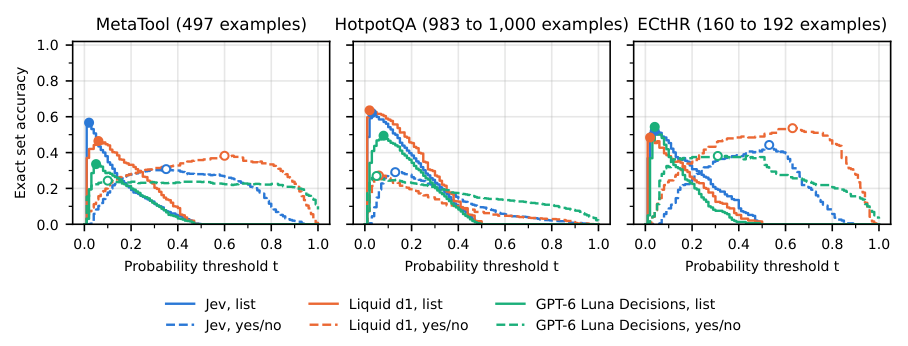
Original figure from the reviewed paper, reused without redrawing. See figure provenance.
Core equations
Threshold with greater-than-or-equal, report exact-set accuracy and pooled micro P/R/F1, below-uniform correct options under strict ranking, max probability in no-correct lists and abstentions. Abstention fails even for empty truth. Author curves reuse one dataset retrospectively; local threshold tuning searches 0–1 in 0.01 steps on validation, tie to smallest, freezes on test and rejects overlapping IDs. Binary ECE uses ten equal-width (low,high] bins with zero in first; excluding first renormalizes the remainder. Explicit two-decimal option; no implicit rounding/renormalization. Empty prediction precision is locally zero rather than author's occasional NaN.
Results reported by the authors
The authors see asymmetric mass even with five identical correct copies, and simple thresholds do not fix complete recovery/calibration. These are paid-model observations, not local capability measurements.
Local reproduction and limits
PublicChoiceList exposes ID, question and options; collect_public_predictions rejects evaluator rows carrying the correct set. Join predictions and labels only at scoring; interface checks do not sandbox a malicious closure. Eight CPU contracts cover ranking/set difference, below-uniform counts, threshold freeze, disjoint IDs, abstention, unlabeled callback, copy-gap reference and excluded-bin normalization. Three seeds are fixtures, not capability or Evolve evidence.
PYTHONPATH=src python -c 'from auto_research.system_one.multicorrect import diagnostic; print(diagnostic(42))'
python -m pytest tests/test_jev_multicorrect.py
Full experiment: not reproduced
The full three-model large-list paid API study was not reproduced. No substitute response data, API calls, automatic retry or claim of comparable model performance.