简体中文 · English
It Takes Workflows to Evolve Better Workflows
L1 core mechanism diagnostic. Structure-aware credit redistribution conserves total credit. No workflows are generated, Qwen3.5 trained or DataWright run.
Paper information
| Field | Details |
|---|---|
| Paper | arXiv 2610.01026 |
| Institution | William & Mary (first author affiliation) |
| First public release | 2026-10-01 (arXiv v1) |
| Original source code | No public author implementation found as of 2026-10-02. |
| Adapter | flowright |
| Local reproduction code | src/auto_research/agent_research/latest_20261002.py |
Original paper summary
Background and main changes
Use workflow topology to turn sparse outcomes into hierarchical, structure-aware role credit. A single harness can then support single-role self-improvement, upstream/downstream collaboration or multi-agent co-evolution.
flowchart LR
  I[Input and current state] --> M[Structure-aware role credit]
  M --> A[Auditable intermediates]
  A --> O[Output or state update]
Key figure from the paper
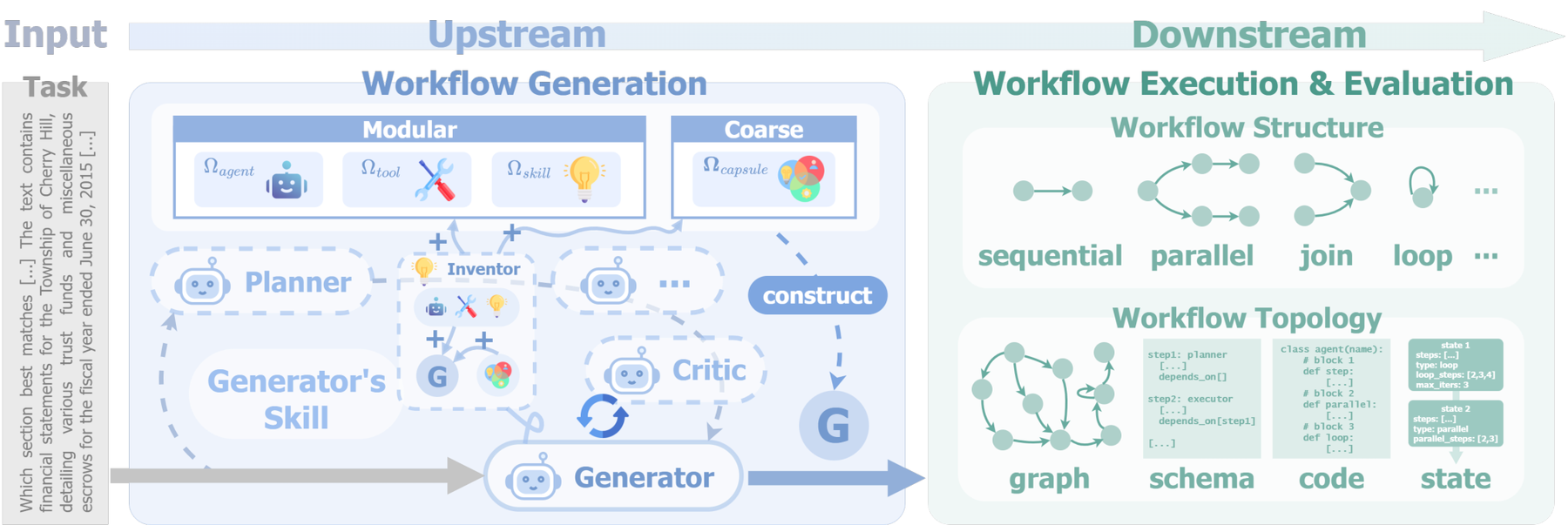
Paper figure: Core architecture, training flow or protocol. From the paper; copyright belongs to the authors. Click for the source.
Core equations
\(r_i=R\,w_i/\sum_jw_j\), where \(w_i=valid_i(1+children_i)\).
Offline and online results
The paper reports gains up to +7.41% across document, slide, chart, coding, math and finance tasks, with +5.03% overall for joint multi-role evolution versus +2.83% for one role.
Local reproduction
Comparison protocol: Disabled or default mechanism versus enabled operator. Relative percentages are not applicable; this checks invariants, gradients or state transitions, not paper-scale effects.
- Three-seed diagnostic:
metrics/mechanism-seeds42-44.json. diagnostic_only=true; excluded from formal capability rankings.
Scope
Structure-aware credit redistribution runs. No workflow generation, Qwen3.5 training or DataWright.