RLAIF: Use AI feedback instead of costly human preference labels
Core mechanism diagnostic, not the original full benchmark.
Paper information
| Field | Details |
|---|---|
| Paper | RLAIF (arXiv 2309.00267) |
| Institution | Google Research / Google DeepMind. |
| First public release | 2023-09-01 (arXiv v1) |
| Author code | No standalone author training repository found or released. |
| Local adapter or method key | rlaif |
| Local reproduction code | src/auto_research/post_training/ |
Paper method and evidence
An AI labeler judges candidates in both presentation orders. Average away positional bias and train the preference policy with the paired labels.
flowchart LR
  C[Candidate pair] --> A[Judge both orders]
  A --> B[Average preference labels]
  B --> P[Pairwise policy update]
Original paper figure
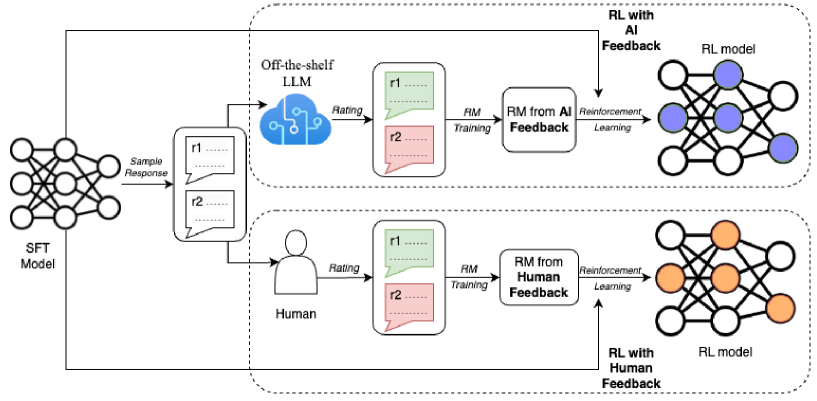
The original figure shows AI feedback and policy training. From the original paper; copyright remains with the authors.
Core equation
Reported results
The paper reports comparable performance to RLHF on summarization and helpful/harmless dialog, with stronger direct-RLAIF. No production A/B.
Local reproduction
Arithmetic candidate suite, 120 steps, 256 examples, seed 42: accuracy 0.2344→0.6406 (+173.33%) with matching reward, KL, length and candidate budgets.
auto-research post-train --algorithm rlaif --dataset arithmetic-smoke --maximum-examples 256 --steps 120 --seed 42
auto-research evolve --model post-training --dataset arithmetic-smoke --direction "Combine rlaif with installed paper operators" --generations 2 --population 4
Fixed metrics. Checks objective and state updates under a fair budget, not large models, multi-GPU RL, private or live web environments, or paper-scale scores.