Residual Advantage: Student-Relative Teacher Guidance for RL with Verifiable Rewards
Core mechanism. Short-budget runs on real checkpoints validate the training path, not paper-scale capability.
Paper information
| Field | Details |
|---|---|
| Paper | Original paper |
| Organization | First-author affiliations: Harbin Engineering University / Tencent / Harbin Institute of Technology |
| First public release | 2026-10-08 (arXiv v1) |
| Authors' code | No author-released code was found as of 2026-10-10. |
| Local adapter | residual-advantage |
| Local reproduction code | oct10_objectives.py, oct10_checkpoint.py |
Original paper
Motivation and method
Full-vocabulary teacher–student probability residuals become bounded, student-relative local advantages. These are centered per response and added to the verifier advantage. Co-RA updates teacher LoRA on the same scored student batch and uses the new teacher only in the next round.
flowchart LR
  B[Same student batch] --> R[Full-vocabulary teacher-student residual] --> E[Student expectation baseline] --> C[Response-level centering] --> P[Student PPO update] --> T[Teacher LoRA update] --> N[Teacher for next round]
Key figure from the paper
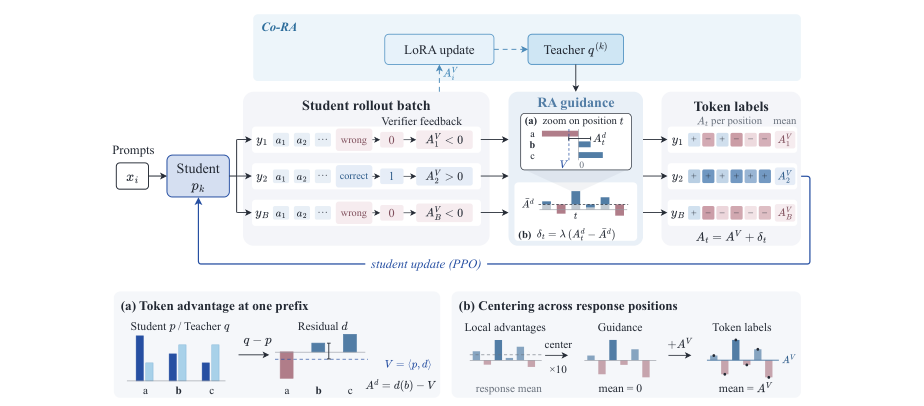
Figure 2: After student sampling, the verifier supplies response-level advantages and the teacher–student residual gives token-level guidance. The student is updated after centering over response positions; Co-RA also updates the teacher with verifier feedback. From the original paper; copyright remains with the authors.
Core equations
\(d=q-p\), \(a_t=d(y_t)-\sum_vp(v)d(v)\), and \(A_t=A_{\mathrm{verifier}}+\lambda(a_t-\bar a)\). Co-RA updates the teacher only with fixed verifier advantages. Score first, update the two policies separately, and do not recompute labels mid-update.
Paper results
RA improves the underlying sequence-advantage algorithms in all 24 reported comparisons, and Co-RA further improves Avg@8. No online A/B test is reported.
Local reproduction
See the checkpoint guide for installation, data formats, and commands.
Core entry points are residual_advantage / co_ra_step. The checkpoint runner is scripts/run_oct10_post_training.py --objective residual-advantage. Use --objective co-ra for Co-RA.
Explicitly supply a local checkpoint path, public model ID/revision, public GSM8K train and validation JSONL, data revision, and an output directory. See python scripts/run_oct10_post_training.py --help for options. No automatic downloads or private data uploads. Teacher and student vocabularies must match token for token. The runner supports causal LMs with q_proj and v_proj; base parameters stay frozen while LoRA trains.
Data protocol and results
The generator reads only questions, and answers are reserved for an external numerical verifier. Train/validation overlap raises an error. Isolated validation runs after training and does not select hyperparameters. Outputs retain seed, data hashes, checkpoint revision, token counts, loss, and measured parameter changes.
A real NVIDIA A100 ran LoRA training for a Qwen3-4B student and public MOPD teacher at seed 42 for two steps. The student had two effective gradient steps and adapter parameter change of 0.020295 in \(L_2\). Exact match was 0.5 on two isolated validation questions, insufficient to claim a gain. See measured results and sanitized GPU evidence.
Truncation, a small question count, and one seed support only a runtime smoke test, not improved mathematics capability.
Co-RA separately ran 10 same-batch student/teacher updates with four responses per question and 512 tokens. All 10 student steps and one teacher step had effective gradients; the teacher peak was 0.124529 and teacher LoRA change was 0.028806 in \(L_2\). The maximum response-mean error in guidance advantage was \(5.97\times10^{-8}\). The teacher rescored only in the next round, after the fixed-label update. Frozen base parameters are not in the teacher optimizer. See Co-RA measurements; the GPU receipt includes the additional command. Small-sample validation is still not a capability comparison.
Code mapping and reproduction limits
oct10_objectives.py contains formulas and selectors. oct10_checkpoint.py implements LoRA, rollout, teacher scoring, optimization, and validation. Contract tests are tests/test_oct10_objectives.py and tests/test_oct10_checkpoint_contracts.py. The original training data, full budget, and multi-benchmark controls have not been reproduced. The method is not integrated into the multi-round evolve controller; a catalog label does not establish integration.