Attribution Sets: Risk estimation from weak attribution signals
Standalone CPU math component, no
reproduceadapter or Evolve promotion. Formula execution is not proof of unbiasedness. Full experimental grid too costly and not reproduced (review DONE).
Paper information
| Field | Details |
|---|---|
| Paper | Paper or original source |
| Institution | Google Research; listed-first Lorne Applebaum, with authors ordered alphabetically |
| First public release | 2026-02-06 (arXiv v1) |
| Author code | No author implementation found in reviewed v1; this is not a global claim. |
| Local adapter or method key | attribution-sets |
| Local reproduction code | src/auto_research/reproductions/attribution_sets_components.py |
Paper method and evidence
One conversion may map to an overlapping set of candidate clicks. With no true assignments, decompose binary loss into a label-independent term and a label-dependent moment. Use position priors and binomial tail probabilities to estimate risk and squared-prior weighting for ERM, rather than random or max-prior pseudo-labeling. Implement printed v1 literally and preserve its failed finite-sample identity check. v1 Section 3 Theorem 1 and Section 4.1 Eqs. 6–7.
flowchart LR
  A[Candidate click sets] --> B[Position priors and binomial tails]
  B[Position priors and binomial tails] --> C[Estimate binary risk]
  C[Estimate binary risk] --> D[Finite empirical risk selection]
Original paper figure
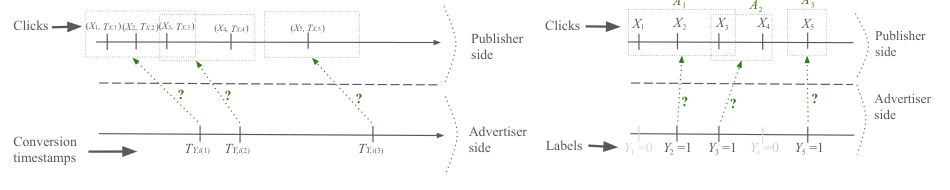
Figure 1 (PDF page 5) shows clicks, delayed conversions and possibly overlapping sets. Its latent variables are not learner inputs. Source, crop and hash. From the original paper; copyright remains with the authors.
Core equation
The implementation keeps \(1\{j\le M-k\}\) and the fixed Eq. 6 denominator.
Reported results
The paper simulates attribution sets on MNIST, CIFAR-10 and Higgs vs random/max-prior baselines. No real production A/B or full rollout. User-approved mathematics component, not an industrial lift reproduction.
Local reproduction
unbiased_cell implements the printed equation, despite the target name; squared_risk follows Eq. 6 and finite_erm searches finite hypotheses. The original binomial tail, indicator and fixed Eq. 6 denominator are retained without observed-window renormalization. Singularities error rather than clamp. Population moments and priors are explicit inputs; plug-in estimates do not inherit exact unbiasedness.
Only small constructed fixtures: singleton sets match true risk over exhaustive hidden streams. Multi-element coefficients fail a constant-function check when \(B=B_{n,p,j+k}<1\); \(n=10,p=0.3,j=k=2,\pi=(0.6,0.4)\) gives a reproducible counterexample. This concerns the printed finite-sample identity, not a proof the whole paper is invalid or an author correction. No silent fix. CPU metrics. A roughly 7,800-run, 100–200 epoch matrix was not run; no public-data training, recommendation gain or Evolve promotion.