LARF: reasoning supervision in training, relevance classification in serving
L1 CPU reward/objective components, diagnostic only. The private full pipeline and production experiments are too expensive and not reproduced (review DONE); this is neither complete LARF nor a promotion-eligible capability.
Paper information
| Field | Value |
|---|---|
| Paper | LARF, fixed v1; PDF |
| Institutions | First author Tian Tang: Yuanbao Team, Tencent; Guo Chen also lists Southwest University |
| Original publication | 2026-11-24 07:41:25 UTC, original arXiv v1 submission. Its announcement date is absent from this batch's pool, not inferred |
| Author code | No public method repository is found/verified in fixed-v1 text or its links. Commit and license are unknown; the cited Dual-Head paper is not LARF source code |
| Local adapter / key | larf, identity recommendation:larf; adapter: null |
| Local code | src/auto_research/reproductions/larf_components.py |
Original method
Motivation and changes
LARF models semantic relevance, authority, quality, timeliness and overall relevance as five ordinal labels in0–5. Stage1 synthesizes label-conditioned multi-agent CoT for SFT. Gold is used for training targets and offline checking, not exposed to an evaluated agent. Stage2 combines attribute, within-query ordering and rule-consistency rewards with a direct margin on six terminal digit logits. Stage3 jointly trains five classification heads and an auxiliary generation head; serving discards generation instead of decoding CoT token by token.
Original paper figure
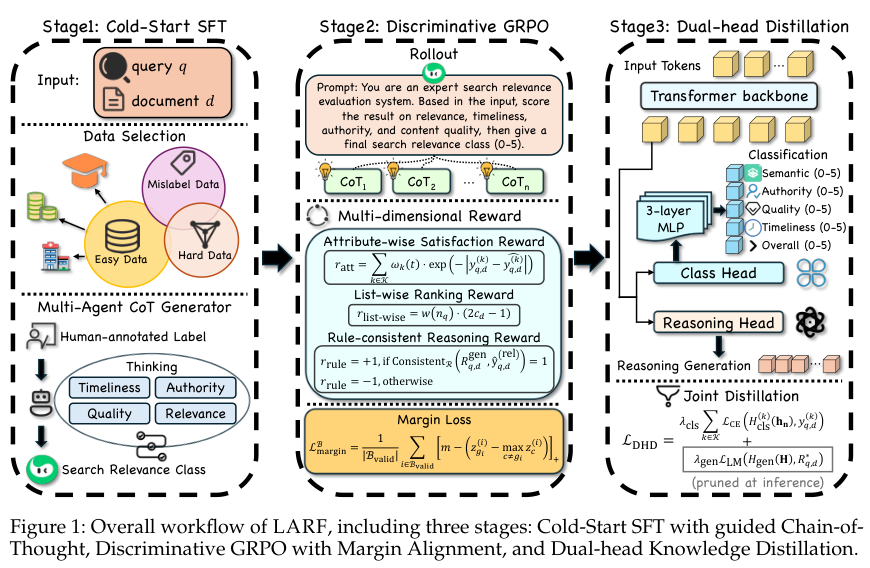
Image from the original paper, Figure1. Copyright belongs to the original authors. Cropped from fixed-v1 page4 with caption intact, not local training evidence. Provenance and SHA.
flowchart LR
    S[Selected training data and training-side gold] --> C[Multi-agent CoT cold-start SFT]
    C --> R[Attribute / ordering / rule rewards]
    R --> G[DGRPO plus terminal margin]
    G --> D[Five class heads plus generation objective]
    D --> O[Classification-only serving]
Core equations
Section4.3, Eqs.2–7 require caller-supplied dynamic weights \(\omega_k(t)\) and rule-checker outcomes. Neither is guessed locally.
Equal-gold document pairs are excluded from P/N/T. A predicted tie receives half credit, correct order is positive and inversion negative. The external checker supplies \(r_{rule}\in\{-1,+1\}\); label equality is not a replacement checker.
Eqs.8–10 apply the following loss to the six digit logits at a uniquely identifiable terminal position:
The strongest competitor is selected across all non-gold classes, not only adjacent grades. Some prose discusses adjacent boundaries, but the equation is not rewritten. Samples without exactly one terminal position or a valid0–5 gold are excluded; the loss averages the valid subset.
Section4.4, Eq.12:
Generation supplies training-time shared-representation supervision; it is not deleted during training. Figure1 labels a three-layer MLP while Section5.5 describes head linear projections, leaving full network details insufficiently specified. Local code implements the supplied-logit objective and both gradients, not a reconstructed network or teacher-to-student pipeline.
Author-reported evidence
Table1's8B series improves six-class accuracy from45.20% to50.98% and NDCG from74.51 to79.56. The deployed1.7B student has45.80% accuracy and75.20 NDCG;8B results must not be assigned to it. Table6 reports0.97s/pair for the multidimensional classification configuration versus5.68s AR, an82.9% reduction measured on64 H20 GPUs, not single-GPU latency.
Section5.6/Table5 explicitly reports a real Yuanbao AI Search production A/B against the production baseline: LARF-1.7B has HSR(grades3–5)+1.77%, LSR(grades0–1)−3.22%, RS+3.63% and CS+2.49. Allocation, sample size and duration are undisclosed. Preserve the original percent notation without inventing percentage points or significance. These are author-reported, not local results.
Comparison
Yuanbao Rubric uses query-specific positive/negative criteria across retrieval, ranking and set selection, distilling the best group trajectory for poorer trajectories. LARF supervises five-dimensional document decisions, within-query pair order and a terminal digit. Its PNR is not multi-document rubric coverage; its dual-head loss is not best-trajectory distillation. Their online metrics and pipelines differ, so lifts are not directly comparable or additive.
Local components
Inputs and code
The module consumes external training labels, predictions, weights, rule booleans, logits and masks, implementing Eqs.2–10/12. There is no evaluated-agent interface receiving gold. listwise_reward handles one query group and rejects no-comparable-gold groups or mean group size at most1 because the original denominator is undefined. First-competitor selection under ties and zero subgradient at the hinge boundary are local conventions.
dual_head_objective sums five independently batch-mean class CEs. The LM term averages valid rationale tokens, an explicit local reduction where the paper gives no detail. Both logit gradients are returned; no backbone/MLP or parameter update is included.
PYTHONPATH=src python -c 'from auto_research.reproductions.larf_components import diagnostic; print(diagnostic(42))'
PYTHONPATH=src:scripts python -m pytest tests/test_nov25_post_components.py -q
Results, controls and limits
CPU seeds42/43/44 were executed. Stable metrics have maximum margin finite-difference error below\(7.0\times10^{-11}\). Independent tests also check every dual-head logit gradient, masking, non-digit zeros, valid-subset reduction, gold-tie exclusion, predicted-tie zero centering and inversion penalties. Removing generation loss gives zero generation gradient as a control.
No dataset, LLM, CoT generator, real rule checker, GRPO, network training or online serving was executed. These checks cannot establish accuracy, latency or user-satisfaction benefits. Only CPU is supported, with requires_gpu_validation=False and no Evolve integration.
Full-experiment cost
Section5.1 uses private approximately300K training/16K test instances. The main text has8B/235B teachers and a1.7B student; AppendixA.2 describes235B construction,64 H20 training,8192 tokens,2 epochs and GRPO rollout8. Do not collapse different backbones into one budget. Full private synthesis, RL, distillation and production A/B exceed one A100/A30 or a Mac: too expensive, not reproduced (review DONE), without downloads/probes, automatic retry or a training backlog.