SASRec: Self-Attentive Sequential Recommendation
Fidelity: Full core pipeline. The model, paper's pairwise BCE training objective, and sequential inference all run. Public data is scaled from MovieLens-1M to MovieLens-100K and evaluated with a stricter full-catalog protocol.
Paper information
| Field | Value |
|---|---|
| Paper link | arXiv 1808.09781 |
| Organization | UC San Diego |
| First published | 2018-08-20 (arXiv v1) |
| Original author code | Yes: official author code. |
| Adapter | sasrec |
| Local reproduction code | src/auto_research/reproductions/sasrec/ |
Original paper summary
Background and main changes
Markov chains favor recent behavior; RNNs compute step by step. SASRec uses causal self-attention to select behaviors relevant to the next item, giving a more flexible receptive field across sparse and dense data. It became a common sequential recommendation baseline.
flowchart LR
    S["Chronological item IDs"] --> E["Shared item embeddings plus positions"]
    E --> A["Causal multi-head self-attention"]
    A --> F["Point-wise ReLU FFN"]
    F --> R["Residual + LayerNorm"]
    R --> T["Dot product with shared item embeddings"]
    T --> O["Full-catalog next-item scores"]
Key figure from the paper
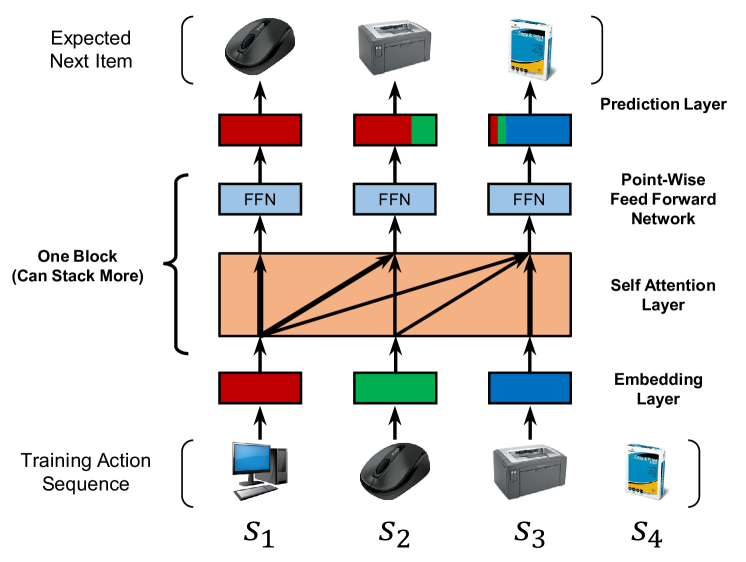
Original Figure 1 (training): Training flow and key optimization steps. Image from the original paper; copyright belongs to the authors. Click the image for its source.
Core equation
For sequence representation \(E\), each layer computes:
Input item embeddings and output classifier weights are tied. Pairwise BCE over the positive item and a sampled negative at each position preserves the paper's objective.
Offline and online results in the paper
- Offline: with the ground-truth item and 100 sampled negatives, Hit@10/NDCG@10 are 0.4854/0.3219 on Beauty, 0.7410/0.5360 on Games, 0.8729/0.6306 on Steam, and 0.8245/0.5905 on MovieLens-1M.
- Online: no production A/B is reported.
SASRec is a user-approved named exception for a classic baseline, not a change to the quantified online A/B requirement for new industrial papers.
Local reproduction
Control: Popularity versus SASRec. NDCG@10 falls from 0.02969 to 0.02933 (-1.24%). This compares models, not a SASRec component ablation.
MovieLens-100K has 932 eligible users and 1,682 items, with chronological leave-two-out. Seeds 42/43/44 each run 320 steps on Apple MPS. Full-catalog evaluation is substantially harder than 100 sampled negatives, so absolute scores are not comparable with the paper.
| Model | Hit@10 | NDCG@10 | Head share@10 |
|---|---|---|---|
| Popularity | 0.06009 | 0.02969 | 1.00000 |
| SASRec | 0.05830 ± 0.00395 | 0.02933 ± 0.00051 | 0.97775 |
SASRec NDCG@10 is -1.24% relative to popularity. Three seeds give similar results without beating the strong popularity baseline. The run provides a reusable neural sequence baseline with a clear protocol and exposes head bias under a short budget.
See metrics/movielens-100k-seeds42-44.json.