CLIP: Learning Transferable Visual Models From Natural Language Supervision
Core dual-encoder mechanism on public images, not paper-scale zero-shot training.
Paper information
| Field | Details |
|---|---|
| Paper | arXiv 2103.00020 |
| Institution | OpenAI. |
| First public release | 2021-02-26 (arXiv v1) |
| Author code | openai/CLIP. |
| Local adapter or method key | clip |
| Local reproduction code | src/auto_research/reproductions/clip/ |
Paper method and evidence
Independent image and text encoders project paired samples to the same unit sphere. A symmetric in-batch contrastive objective learns reusable zero-shot representations.
flowchart LR
  I[Image encoder] --> N[Normalized image features]
  T[Text encoder] --> V[Normalized text features]
  N --> C[Symmetric contrastive matching]
  V --> C
Original paper figure
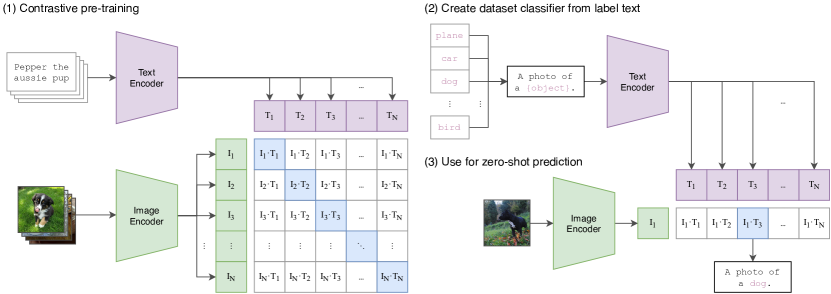
The original figure shows the paired contrastive objective and zero-shot use. From the original paper; copyright remains with the authors.
Core equation
Reported results
Pretraining uses 400 million image–text pairs. ImageNet zero-shot matches the original supervised ResNet-50; evaluation spans more than 30 datasets.
Local reproduction
On ten classes of real Fashion-MNIST images paired with class text, uniform random is 10.0%. The symmetric dual encoder reaches 72.0% (+62.0 percentage points); shuffled images reduce it to 10.3%, confirming dependence on visual input.
Fixed metrics. No 400M pairs, natural-language long-tail semantics, or large vision encoder. A small one-seed run is not the original zero-shot result.