Random Attention: KV-cache eviction without importance scoring
Core mechanism plus real-checkpoint GPU validation. Keeps the full prompt and independently samples the generated trace uniformly for each head.
Paper information
| Field | Details |
|---|---|
| Paper | Salesforce AI Research preprint |
| Organization | Salesforce AI Research / University of Illinois Urbana-Champaign |
| First public release | 2026-09-03 (arXiv v1) |
| Authors' code | Public implementation |
| Adapter / method | random-attention |
| Local reproduction code | src/auto_research/reproductions/random_attention/ |
Original paper
Motivation and method
Conventional KV eviction first estimates token importance. Random Attention protects the prompt and retains a fixed budget from generated tokens with independent uniform samples per head. It avoids the scoring pass and does not force all heads to share a ranking rule.
flowchart LR
  P[Full prompt KV] --> K[Keep]
  T[Generated trace KV] --> S[Uniform sampling per head]
  K --> A[Sparse attention]
  S --> A
Key figure from the paper
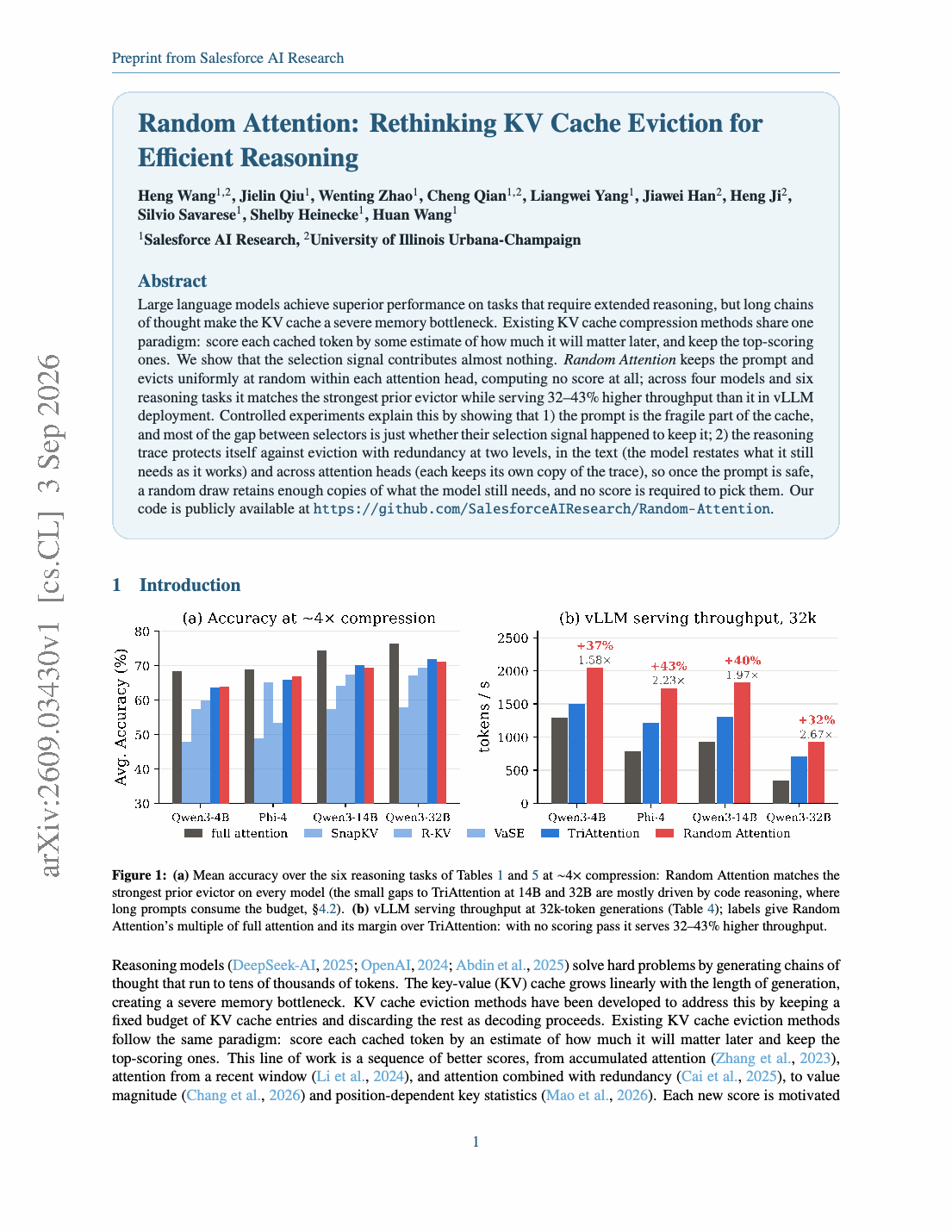
Key figure: Overview of the paper's method and results. From the original paper; copyright remains with the authors.
Core equation
For head \(h\), retain \(K_h=P\cup\operatorname{UniformSample}(T,B-|P|)\), where \(P\) is the full prompt and \(T\) the generated trace. Heads sample independently, without token importance scores.
Paper results
Across four models, six tasks, and 32k context, the paper reports maintained reasoning quality under the same KV budget. Its vLLM integration improves throughput by 32%–43% versus the strongest importance-based eviction baseline.
Local reproduction and GPU evidence
See the three-seed CPU mechanism results and the A100 receipt for a real Qwen3-4B checkpoint and fixed public-domain long-text probe. Validation uses a strict equal-budget prompt-plus-recent baseline.
Local comparison: On CPU seed 42, attention cosine is 0.97996 for the equal-budget recent baseline and 0.46664 for random selection, a relative -52.38%. The real-checkpoint A100 diagnostic is 0.99996 and 0.94002, respectively. Neither establishes task-accuracy improvement.
Reproduction boundaries
The paper's six-task matrix and official vLLM-kernel throughput were not reproduced. Local GPU execution verifies selection and attention reconstruction on actual KV tensors and can serve as an LLM evolve attention operator.